

Sora Review 2026: The New Frontier of Generative Video & Social Expression
OpenAI Sora (Sora 2) is a state-of-the-art video generation platform that transforms text and images into cinematic, high-fidelity videos with synchronized audio. Built on a diffusion transformer architecture, Sora 2 excels at simulating complex physics and maintaining character consistency across multiple shots. Beyond its professional utility for filmmakers and marketers, the 2026 ecosystem includes a mobile-first social app, allowing users to remix creations, use personalized “Cameo” avatars, and share AI-generated stories instantly.
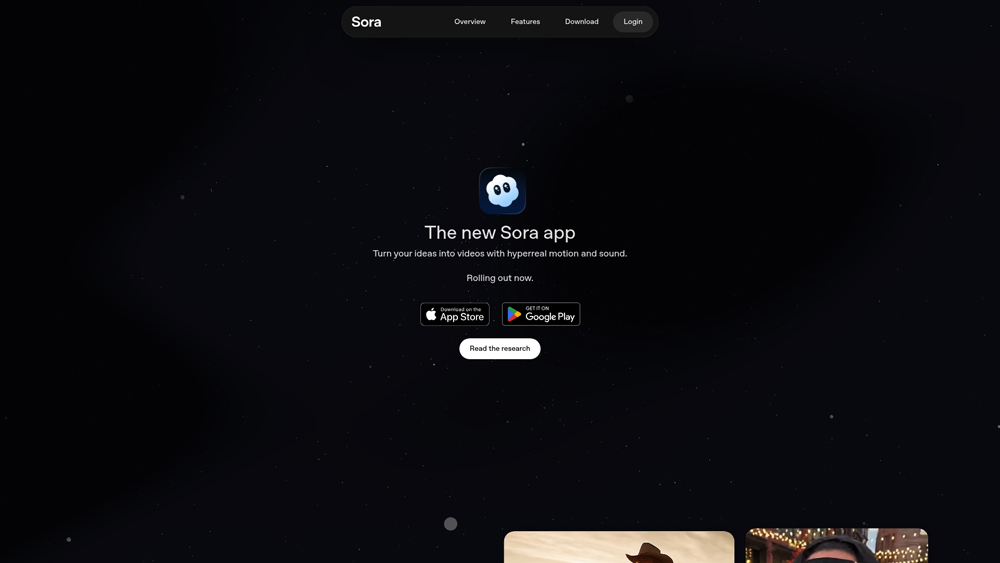
In-Depth Review & Visual Capability Analysis
Sora has moved beyond simple novelty to become a production-ready engine. We evaluate its performance based on “visual grounding”, the model’s ability to respect gravity, lighting, and object permanence. Sora 2 significantly reduces the ‘hallucination’ of impossible physics, making it viable for professional storyboarding and commercial backgrounds. By integrating with the broader OpenAI ecosystem, it now allows for seamless “Text-to-Video” and “Image-to-Video” workflows that include high-quality, synchronized sound design.
Key Takeaways: Pros, Cons & Quick Summary
This summary outlines the strengths of Sora’s cinematic output against the practical challenges of high-end AI video production in 2026.
Key Advantages (Pros)
- Hyper-Realistic Physics: Sora 2 accurately simulates fluid dynamics, weight, and collisions better than any current competitor.
- Synchronized Audio: Generates environmental sounds and character dialogue that perfectly match the visual timeline.
- Disney & IP Partnerships: Official licensing allows for the legal generation of 200+ iconic characters from Disney, Marvel, and Star Wars.
- Character Continuity: Superior “Character Cameo” system keeps faces and outfits consistent across different scenes and angles.
- Social Remixing: The Sora app enables a community-driven workflow where users can branch and edit each other’s clips.
Potential Drawbacks (Cons)
- Short Clip Limits: High-quality “Pro” generations are still capped at approximately 25 seconds per clip.
- High Inference Costs: Pro-tier and API usage fees remain significantly higher than text or image-based AI tools.
- Strict Moderation: Aggressive safety filters can occasionally block legitimate creative prompts involving minor action or drama.
Core Features: Sora 2 Omni-Sync & Cameo Systems
Since its public rollout, OpenAI Sora has transcended being a mere “video generator” to become a dominant cultural force in the creator economy. Sora 2, the 2026 flagship update, has evolved into a comprehensive creative suite that bridges the gap between simple text-to-video and professional film production. This version focuses heavily on the “Omni-Sync” framework, which treats audio and video as a single, inseparable data stream, ensuring that every frame is harmonized with its sonic counterpart. We focus on the features that have defined this massive update, particularly the leap into synchronized media and personified AI avatars.
-
Native Audio-Video Omni-Sync: Sora 2 doesn’t just “add” sound as a post-process effect; it generates it natively within the diffusion process. This means that dialogue matches lip movements with sub-millisecond precision, and ambient noise, such as the specific echo of footsteps in a cathedral or the metallic whirr of a futuristic coffee shop, aligns with on-screen actions in real-time. This “diegetic audio” capability has essentially eliminated the need for third-party foley tools in short-form content creation.
-
Character Cameos & Identity Verification: Perhaps the most popular feature of 2026, the Cameo system solves the “identity drift” problem that plagued early AI video. By uploading a short, 10-second verification video of yourself, Sora creates a “Digital Cameo” profile. This allows you to star in your own generated cinematic sequences with 100% likeness retention across different scenes, lighting conditions, and camera angles. Strict safety protocols ensure that you can only generate Cameos of yourself or individuals who have provided cryptographically signed consent.
-
Remix Engine & Viral Social Feed: The integrated Sora App (widely known in the community as ‘SlopTok’) features a TikTok-style infinite scroll driven by a natural language recommendation system. The “Remix” button allows users to take any viral video and instantly modify the setting, art style (e.g., changing photorealism to Studio Ghibli anime), or lighting, all while keeping the original motion data and character choreography intact. This has created a new genre of “collaborative AI storytelling” where one prompt evolves through thousands of community iterations.
-
1080p Cinematic Output & Virtual Glass: Standard generations now support Full HD 1080p at a smooth 30fps, while Pro tiers offer 4K “Film Mode.” A key addition is the “Virtual Lens” system, which allows users to prompt for specific cinematic hardware. You can now request a “35mm anamorphic look with heavy bokeh” or a “12mm ultra-wide GoPro aesthetic,” and Sora will simulate the specific optical distortions and color science associated with those lenses.
Architectural Innovation: Diffusion Transformers (DiT) & World Logic
Sora’s unprecedented realism is rooted in its “Diffusion Transformer” (DiT) architecture. By treating video frames as “spatiotemporal patches”, essentially 3D tokens, the model can maintain a deep internal map of the scene’s geometry. This allows Sora to “foresee” future frames and maintain “object permanence,” a critical breakthrough where a subject doesn’t disappear or change shape when it moves behind an object or exits the frame temporarily.
- Advanced World Simulation: Sora 2 models cause-and-effect with frightening accuracy. In previous versions, a ball might “teleport” to a hoop to satisfy a prompt; in Sora 2, the model understands physics. If a glass falls, it shatters based on its material properties; if a character takes a bite of a sandwich, the bite mark persists through the rest of the clip. This “physical grounding” makes Sora an invaluable tool for pre-visualization in the professional film industry.
- Latent Space Compression & Speed: Despite the jump in quality, Sora 2 is significantly more efficient. By working in a highly compressed mathematical “latent space,” the model can generate 20-second HD clips up to 40% faster than the original Sora 1.0 research preview. This efficiency has allowed OpenAI to offer “Real-Time Previews,” where users can see a low-resolution thumbnail of the video’s motion just seconds after hitting the ‘Generate’ button.
Performance, Speed & Professional User Experience (UX)
As Sora has transitioned from a research demo to a commercial product, the focus has shifted toward reliability and professional-grade UX. Performance testing in 2026 shows that Sora 2 handles high-load conditions far better than its predecessors, with a backend optimized for the massive compute requirements of high-fidelity video diffusion.
- Inference Speed & Streaming: Sora 2 has introduced a “Streaming Render” mode. For Pro and Enterprise users, the video begins playing back as it is being generated, reducing the “perceived wait time” to nearly zero. This near-instant feedback loop is essential for creators who need to iterate on complex prompts quickly without waiting minutes for a final file.
- Storyboard Interface & Multi-Shot Control: The UI has evolved from a simple text box into a “Director’s Dashboard.” Users can now use the Storyboard tool to chain up to five shots together, maintaining character and environmental consistency across a full narrative arc. This tabbed structure allows for easy management of different “takes” and “remixes,” significantly reducing the cognitive load for professional editors.
- Robust Error Correction & Prompt Guidance: Sora 2 features an “Internal Director” (powered by a GPT-5 class model) that analyzes prompts for physical or logical contradictions. If a prompt is ambiguous, such as asking for a “fast-moving snail”, the system will offer clarifying suggestions or “Director’s Notes” to ensure the resulting video meets the user’s intent rather than failing or producing a visual glitch.
Sora Pricing & Professional Value
As of 2026, Sora is tiered based on compute requirements. Basic 10-second clips are available to Plus users, while the high-fidelity Sora 2 Pro (1080p, 25s) is reserved for the Pro and API tiers to manage GPU demand. Note: Free access was discontinued in Jan 2026.
PLUS TIERCasual Social$20
- Price: $20/mo
- Credits: 1,000 Sora Credits
- Limits: 720p / 15s max
- Best For: Content Creators
API / PAYGODevelopers$0.10
- Price: $0.10 – $0.50/sec
- Compute: Dedicated GPU Pipeline
- Resolution: Custom Aspect Ratios
- Best For: App Integration
ENTERPRISEFull ControlCustom
- Price: Contact Sales
- Features: Private Fine-Tuning
- Rights: Commercial IP Indemnity
- Best For: Major Media Brands
Note: Sora pricing is heavily credit-based in 2026. A 5-second 1080p clip typically consumes ~200 credits. Commercial rights for “Character Cameos” may require additional licensing via the Sora Marketplace. Always verify current rates at sora.com/pricing.
Product Details
Sora 2 (2026) remains the benchmark for temporal consistency and physics accuracy. With the new “Storyboard” tool, users can now direct multi-shot sequences within a single interface, making it the most capable end-to-end AI film production tool on the market.
Platforms Supported
- Cloud (Web)
- iOS App
- Android App
- API Integration
Training
- Video Tutorials
- Documentation
- Community Forum
Support
- 24/7 Priority (Pro)
- Email Support

Prompt Colleague Score
Quick Facts
- Company: OpenAI
- Latest Model: Sora 2 (Pro)
- Max Resolution: 4K / 1080p Standard
- Key Feature: Character Cameos & Sync Audio
- Max Duration: 25 Seconds (Stitchable)
- Free Tier: Discontinued (Jan 2026)
- Official Site: sora.com
Pricing & Credits (2026)
- ChatGPT Plus ($20/mo): 1,000 Credits
- ChatGPT Pro ($200/mo): 10k Credits + Unlimited Relaxed
- API Cost (720p): $0.10 – $0.30 per second
- API Cost (HD): $0.50 per second
- Extra Credits: Pay-as-you-go top-ups available
Frequently Asked Questions (FAQ)
As of 2026, Sora 2 supports video lengths up to 25 seconds for Pro subscribers. Standard users typically generate clips between 10-15 seconds. While longer than previous versions, it is still optimized for high-quality short-form content rather than full-length films.
Yes! Through OpenAI’s landmark $1B partnership with Disney, users can now legally generate ‘interactive fan fiction’ featuring over 200 licensed characters from Disney, Marvel, Pixar, and Star Wars using the ‘Cameo’ and ‘Brand’ modules.
Yes, Sora 2 features native audio-video synchronization. It generates realistic background soundscapes, foley effects, and even lip-synced dialogue that matches the visual characters perfectly, eliminating the need for separate audio tools.
Yes, commercial rights are granted for original content generated on the Pro and Enterprise tiers. However, videos using licensed IP (like Disney characters) are restricted to personal social sharing and cannot be sold or used for independent commercial gain without further studio approval.
The Cameo feature allows you to upload a photo of yourself (or a licensed character) and insert that specific likeness into an AI-generated scene. It maintains character consistency across different prompts, making it ideal for personalized storytelling.
The Sora Video API uses per-second billing. Prices range from $0.10 per second for Standard 720p output to $0.50 per second for Pro HD 1024p/1792p cinematic content, allowing developers to pay only for the exact duration generated.
OpenAI Sora Video APIs
The Sora Video API represents a massive shift for creative tech. By moving to a specialized /v1/videos endpoint, OpenAI allows developers to integrate cinematic-grade motion directly into apps, websites, and marketing stacks. The API-first approach supports both text-to-video and image-to-video (animation) workflows with ultra-low latency compared to early research previews.
With tiered rate limits and per-second billing, the API is built for scale. Enterprise users can utilize the ‘Pro’ model for 1080p broadcast-ready assets, while social media startups can leverage the ‘Standard’ model for cost-effective 720p content. All API outputs include C2PA metadata and invisible watermarking for safety and provenance.
Video Generation Features:
- Text-to-Video
- Image-to-Video
- Cinematic Realism
- Anime Styles
- Portrait (9:16) Support
- Landscape (16:9) Support
- Physics Accuracy
- Temporal Consistency
- 1080p HD Output
- Licensed IP Integration
- Multi-Shot Narratives
- Camera Motion Control
Audio & Interaction:
- Synced Dialogue
- Environmental Foley
- Background Music
- Voice Synthesis
- Lip-Syncing
- Multi-Language Audio
- Sentiment Matching
- Real-time Rendering
- 3D Spatial Audio
- User-Uploaded Music
- Live Dubbing
- Custom SFX Libraries
Safety & Governance:
- C2PA Metadata
- Visible Watermarking
- Provenance Search
- Consent Verification
- Public Figure Blocking
- Automated Scanning
- Teen Safeguards
- Opt-in Licensing
- Facial Recognition Opt-out
- Deepfake Detection
- Legal Indemnity
Product Features In Detail:
OpenAI Sora is no longer just a research experiment; it is a professional production powerhouse. From the integration of world-class IP to advanced physical world simulation, Sora 2 provides creators with a level of control previously reserved for CGI studios. This section details the specific features and guardrails that define the Sora ecosystem in 2026, helping you decide if it fits your professional creative workflow.
The Sora 2 app includes a dedicated ‘Brand Hub’ where users can legally prompt for official characters from Marvel, Star Wars, and Pixar. This is the first time high-value IP has been licensed for consumer AI video generation, enabling a new era of authorized user-generated content.
Sora’s ‘Cameo’ feature is a breakthrough in consistency. By verifying your identity or using a licensed preset, you can ensure the same character appears across multiple scenes, outfits, and environments, solving the ‘character drifting’ issue common in early AI video.
Unlike competitors, Sora 2 generates audio and video in the same pass. The AI understands that a glass breaking should sound like glass breaking and ensures the audio peak aligns perfectly with the visual impact frame, including realistic reverb based on the room size.
The web-based Storyboard tool allows you to direct your video second-by-second. You can upload keyframes or sketches to guide the AI’s motion path, giving professional filmmakers the granular control needed for specific scene beats.
The Pro engine increases resolution to 1080p and extends video duration to 25 seconds. It uses a significantly larger compute budget to minimize pixel shifting and ensure that complex movements—like water flowing or hair blowing—look physically accurate.
OpenAI leads in ‘provenance signals.’ Every Sora video is tagged with industry-standard C2PA metadata. This allows social media platforms and browsers to instantly verify that a video was AI-generated, protecting against misinformation and unauthorized deepfakes.
Sora natively supports 16:9 for YouTube/Film, 9:16 for TikTok/Reels, and 1:1 for Instagram. The model understands the compositional differences required for each, framing subjects differently based on the chosen output format.
The 2026 update to Sora’s ‘world model’ significantly improves how the AI handles gravity and object collision. Objects no longer ‘morph’ through each other, and lighting changes realistically when a character moves between light sources in a scene.
The Top 4 AI Tools: Our Editors' Picks for Instant Productivity!
ChatGPT
AI Assistants
Google Gemini
AI Assistants

Midjourney
Image Generators
Otter.ai
Meeting Assistants