

Amazon Q Developer Review 2026: The Premier AWS Engineering Agent
Amazon Q Developer is a sophisticated AI-driven engineering agent designed to accelerate the entire software development lifecycle. Deeply embedded within the AWS ecosystem, it assists developers with code generation, testing, debugging, and multi-step upgrades. Beyond simple autocomplete, Amazon Q functions as an autonomous partner capable of refactoring legacy code and managing cloud infrastructure through natural language commands in the IDE and AWS Console.
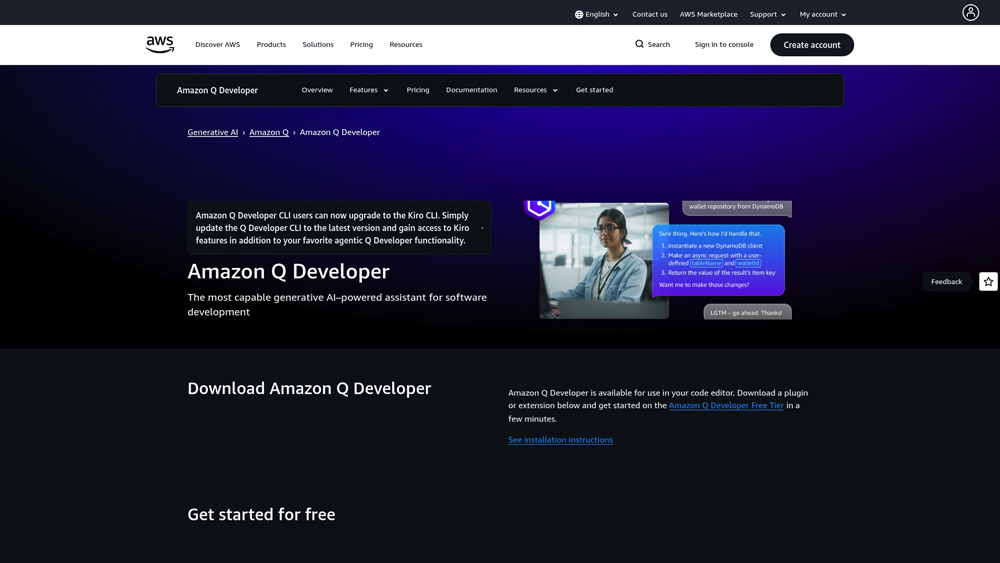
In-Depth Review & Architecture Analysis
Amazon Q Developer has evolved from a basic coding assistant into a comprehensive engineering agent. We evaluate its performance based on its cross-file context awareness, its proficiency in AWS-specific troubleshooting, and its specialized agents for Java and .NET upgrades. This analysis focuses on its impact on enterprise velocity and modern DevOps workflows.
Key Takeaways: Pros, Cons & Quick Summary
This summary highlights why Amazon Q is a critical asset for cloud-native engineering teams while noting its platform-specific dependencies.
Key Advantages (Pros)
- Deep AWS Integration: Native ability to explain AWS bills, optimize Lambda functions, and debug IAM policies directly.
- Code Transformation Agent: Industry-leading capability for autonomous version upgrades (e.g., migrating legacy Java to the latest version).
- Cross-File Context: Analyzes entire repositories to provide logically consistent logic across multiple modules.
- Security Scanning: Performs real-time vulnerability detection and provides one-click remediation for common exploits.
- Generous Free Tier: Provides high-tier capabilities for individual developers without cost, lowering the barrier to entry.
Potential Drawbacks (Cons)
- AWS Ecosystem Bias: Performance is most optimized for AWS environments; potentially less robust for Azure or GCP-heavy stacks.
- IDE Dependency: Requires specific plugins (VS Code, JetBrains) to unlock its most powerful agentic features.
- Complex Pricing: Managing individual vs. professional tiers can become complicated for large-scale enterprise billing.
Core Features: Autonomous Refactoring & Cloud Mastery
Amazon Q Developer sets itself apart by focusing on the ‘heavy lifting’ of software maintenance. By 2026, it has become the leading tool for automated modernization and real-time cloud operations management.
-
Amazon Q Code Transformation: This autonomous agent can take an ancient Java or .NET application and automatically upgrade dependencies, refactor deprecated APIs, and verify the build, saving months of manual work.
-
AWS Console Integration: A unique feature where the AI lives inside the AWS Management Console, allowing you to ask, “Why is my EC2 instance failing?” or “How do I optimize this RDS database?” with direct access to your account metadata.
-
Feature Development Agent: Assign a task from a natural language prompt, and Amazon Q will draft the implementation plan across multiple files, allowing for hands-free boilerplate and logic generation.
-
Proactive Security Remediation: Beyond just flagging risks, Amazon Q provides specific code fixes to resolve vulnerabilities, ensuring your CI/CD pipeline remains secure from the start.
-
CLI & Integrated Troubleshooting: Use Amazon Q in your terminal to explain failed commands or generate complex shell scripts for cloud deployment instantly.
Amazon Titan Models & Engineering Logic
Amazon Q is powered by the Amazon Titan family of models, which are specifically fine-tuned on vast amounts of high-quality code and AWS documentation. This specialization ensures high accuracy for technical tasks compared to broader, general-purpose models.
- Titan Text Premier: Optimized for technical reasoning and architectural planning, this model handles the “Thinking” stage of engineering agents with high precision.
- Fine-Tuned Engineering Intelligence: Because the models are trained on years of AWS internal best practices, the architectural suggestions align with high-performance cloud standards (the Well-Architected Framework).
- Context-Awareness: The 2026 iteration utilizes advanced RAG (Retrieval-Augmented Generation) to maintain context over large-scale distributed systems, not just individual files.
Performance, Latency & DevOps Integration
Performance is measured by how quickly the agent can move from a plan to executed code. Amazon Q excels in environments where speed and cloud connectivity are prioritized.
- In-IDE Latency: Autocomplete and chat responses are nearly instantaneous, keeping developers in a flow state during intensive coding sessions.
- Seamless AWS Hand-off: The transition from local coding in VS Code to monitoring in the AWS Console is handled by a unified AI identity (Amazon Q), creating a cohesive experience across the entire dev-to-prod pipeline.
- Reliability: The system demonstrates high resilience when dealing with complex infrastructure-as-code (Terraform, CDK), often catching deployment errors before they reach production.
Amazon Q Pricing & Enterprise Value (2026)
Amazon Q Developer offers a highly competitive pricing structure designed to scale with team size. The Professional Tier provides advanced agents for code transformation and enterprise security features that are essential for modernizing legacy debt.
FREE TIERIndividual Use$0
- Price: $0/mo
- Models: Amazon Titan (Std)
- Limits: Monthly Agent Caps
- Best For: Individual Devs
ENTERPRISEFull CustomizationCustom
- Price: Per Seat Quote
- Compute: Dedicated Throughput
- Privacy: Custom Model Tuning
- Best For: Global Organizations
AWS CREDITInfrastructure BundleVaries
- Price: Usage Based
- Privacy: SOC 2 Compliance
- Admin: IAM Policy Control
- Best For: Cloud Operations
Note: Amazon Q Developer pricing is integrated into your AWS billing. High-volume usage of the Code Transformation agent or custom model fine-tuning may incur additional costs based on compute time. Always check the AWS Pricing Calculator for the most accurate cost projections for your specific enterprise scale.
Product Details
Amazon Q Developer is a top-tier choice for modern cloud-native software engineering. It offers a level of automation and AWS architectural knowledge that significantly reduces the manual toil of development and maintenance.
Platforms Supported
- AWS Console
- VS Code
- JetBrains IDEs
- Visual Studio
- macOS CLI
- Linux CLI
Training
- Documentation
- AWS Frameworks
Support
- Online AWS Support
- Community Forums

Prompt Colleague Score
Quick Facts
- Company: Amazon (AWS)
- Founded: 2006 (AWS)
- Headquarters: Seattle, USA
- Best For: AWS-Native Engineering & Modernization
- Core Tech: Kiro CLI & MCP Support
- Models: Amazon Nova, Claude 3.7, Titan
- Official Site: aws.amazon.com
Pricing & Access
- Free Tier: 50 Agentic Tasks / Month
- Pro Tier: $19 per user / month
- Transformation: 4k Lines Included (Pro)
- Best Value: Pro Tier (Teams & IP Indemnity)
Frequently Asked Questions (FAQ)
AWS CodeWhisperer has been evolved and rebranded as part of Amazon Q Developer. It now includes all the original real-time coding suggestions plus advanced agentic capabilities like full-repo refactoring, AWS console troubleshooting, and autonomous code transformation agents.
Yes, there is a perpetual Free Tier for individual developers. It includes real-time code suggestions, 50 agentic chat interactions per month (for coding and AWS Q&A), and up to 1,000 lines of code transformation per month for Java or .NET upgrades.
The transformation agent automates legacy upgrades (e.g., Java 8 to 17). It analyzes your repo, identifies deprecated APIs and dependencies, generates a transformation plan, executes the code changes, and runs unit tests to ensure the application compiles in the target version.
You own all code generated or suggested by Amazon Q Developer. Similar to using an IDE, you are responsible for the code you accept, and AWS provides IP indemnity for Pro tier users to ensure enterprise-safe adoption of AI-generated suggestions.
Yes. Through the AWS Console and CLI, you can ask Q to list resources, explain billing anomalies, or generate CLI commands to deploy infrastructure. It can even diagnose console errors and provide step-by-step remediation plans based on AWS best practices.
For Pro Tier users, your content is never used to train the underlying foundation models. AWS adheres to strict data isolation, ensuring your proprietary logic and internal library context remain private to your organization.
Engineering Agent APIs & Integration
Amazon Q Developer is powered by the Amazon Bedrock ecosystem, providing high-performance inference for large-scale engineering tasks. By leveraging specialized models like Amazon Titan and Anthropic Claude 3.7 (via Bedrock), the platform offers a “logic-routing” system that sends specific tasks, like refactoring or security scanning, to the model best suited for that domain. This ensures that complex architectural reasoning is handled with high precision and low latency across global AWS regions.
For enterprise teams, the Q Developer API allows for deeper integration into CI/CD pipelines and internal developer portals. This enables automated security gates that scan every pull request for vulnerabilities and hardcoded credentials. Furthermore, support for the Model Context Protocol (MCP) allows Q to pull context from external services like Jira, Figma, or internal documentation, creating a unified AI brain that understands your entire software development lifecycle.
Cloud Engineering Features:
- AWS Console Chat
- Cloud Cost Analysis
- CLI Command Generation
- IaC Template Generation
- VPC Networking Diagnostics
- IAM Policy Refactoring
- Resource Optimization Tips
- Lambda Function Tuning
- Architecture Q&A
- Multi-Account Visibility
- FinOps Insights
- Best Practice Alignment
Autonomous Coding Agents:
- Multi-file Code Generation
- Agentic Feature Implementation
- Java Version Upgrades
- Unit Test Generation
- Legacy Code Refactoring
- Project-Wide Context (100k Window)
- Vulnerability Remediation
- .NET to Linux Porting
- Code Logic Summarization
- Documentation Generation
- SQL Query Generation
- GitLab/GitHub Integration
Governance & Security:
- IAM Identity Center SSO
- IP Indemnification
- Public Code Suppression
- Compliance (SOC/HIPAA)
- Static Code Analysis
- Credential Leak Detection
- License Reference Tracking
- Organization Policy Controls
- Usage Analytics Dashboards
- Custom Model Fine-tuning
- VPC Endpoint Private Access
Product Features In Detail:
Amazon Q Developer is more than just an autocomplete tool; it is an end-to-end engineering partner that lives in your IDE, CLI, and AWS Management Console. This detailed section explores the core features that differentiate Q from standard chat-based AI, focusing on its ability to modernize legacy stacks, troubleshoot complex cloud networking issues, and maintain enterprise-grade security standards throughout the development lifecycle.
This is Q’s standout feature for legacy modernization. The Transformation agent can autonomously upgrade Java 8 or 11 applications to Java 17/21. It handles the “heavy lifting”—rewriting deprecated methods, updating dependencies, and providing a diff for review—reducing migration projects from weeks to hours.
When a deployment fails or an S3 bucket throws a 403 error, you can click “Diagnose with Amazon Q” directly in the console. The AI analyzes your resource configuration, IAM roles, and VPC settings to provide a specific root-cause analysis and the exact steps to fix it.
Q excels at generating and refactoring CloudFormation and AWS CDK (TypeScript/Python) templates. You can describe your desired architecture (e.g., “Set up a serverless API with Lambda, DynamoDB, and Cognito”), and Q will generate the complete, production-ready IaC code following AWS security pillars.
Integrated directly into the IDE, Q performs continuous security scans. It goes beyond simple regex-based checks to understand code logic, identifying complex vulnerabilities like log injection, insecure data handling, and exposed secrets before the code is ever committed.
Amazon Q brings AI to the terminal. It provides real-time autocomplete for `aws`, `git`, and `docker` commands. If you forget a complex flag, you can ask in natural language (e.g., “q: list all running ec2 instances in us-east-1”) and it will translate that into a runnable CLI command instantly.
Enterprise teams can connect Amazon Q to their own private repositories. This allows the AI to learn your internal APIs, proprietary libraries, and coding standards, providing suggestions that are contextually aware of your specific corporate codebase.
Q Developer can now answer complex billing questions. You can ask “Why did my Lambda costs spike yesterday?” or “Show me a forecast for my S3 usage.” It retrieves cost data, performs calculations, and provides links to the specific console areas for further optimization.
For complex feature development, Q Developer integrates with Kiro—an AI-native environment that focuses on spec-driven development. It turns high-level requirements into structured artifacts, plans, and code, allowing for more structured autonomous engineering than standard chat interfaces.
The Top 4 AI Tools: Our Editors' Picks for Instant Productivity!

ChatGPT
AI Assistants

Google Gemini
AI Assistants

Midjourney
Image Generators

Otter.ai
Meeting Assistants