

LangChain Review 2026: The Premier Framework for Autonomous AI Agents
LangChain is a sophisticated open-source framework designed to simplify the creation of LLM-powered applications and autonomous agents. By “chaining” different components together, it enables developers to build agents that can reason, use external tools, access real-time data, and execute complex task sequences. It serves as the primary orchestration layer for businesses building custom automation pipelines that require more than a simple chat interface.
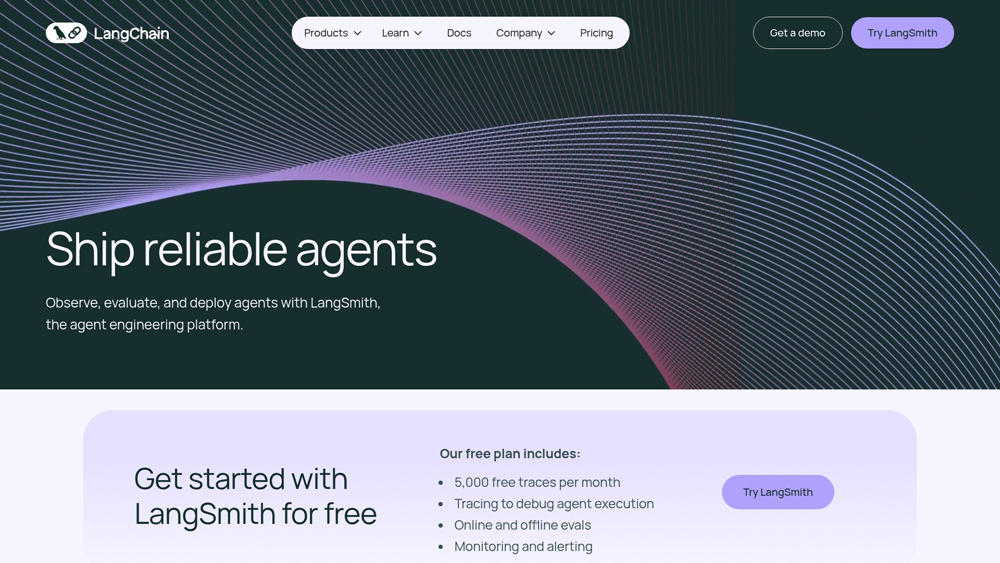
In-Depth Framework Analysis & Agentic Logic
LangChain has redefined the limits of task automation by providing the plumbing for ‘compound AI systems.’ We evaluate its performance across modularity, library breadth, and execution reliability, specifically focusing on LangGraph for stateful agents and LangSmith for debugging. This analysis assesses how LangChain facilitates the shift from passive assistants to proactive, tool-using agents in an enterprise environment.
Key Takeaways: Pros, Cons & Quick Summary
This summary highlights the strengths and technical hurdles associated with deploying LangChain for autonomous task automation.
Key Advantages (Pros)
- Infinite Modularity: Easily swap between different LLMs, vector databases, and memory types without rewriting core logic.
- State-of-the-Art Tool Use: Native support for agents to interact with APIs, web browsers, and SQL databases autonomously.
- Advanced Debugging: LangSmith integration allows for granular tracing of every step in an agent’s reasoning chain.
- Vast Integration Hub: Direct compatibility with 1,000+ tools including Slack, GitHub, HubSpot, and Notion.
- Strong Community Support: Extensive documentation and a massive library of pre-built templates for rapid deployment.
Potential Drawbacks (Cons)
- Steep Learning Curve: Requires significant Python or TypeScript knowledge; not suitable for no-code users.
- Architectural Overhaul: The rapid evolution of the framework can lead to frequent breaking changes in legacy codebases.
- Token Management: Complex agent loops can quickly consume massive amounts of tokens if not strictly monitored and optimized.
Core Features: LangGraph, RAG & Stateful Agents
LangChain offers a robust infrastructure for building “thinking” applications. We focus on the features that enable high-reliability task automation, specifically LangGraph for complex workflows and the comprehensive RAG (Retrieval-Augmented Generation) capabilities.
-
LangGraph for Stateful Workflows: Enables the creation of cyclical agentic loops where an agent can verify its own work, correct errors, and maintain complex state over long durations.
-
Retrieval-Augmented Generation (RAG): Sophisticated tooling for splitting, embedding, and retrieving private document data, allowing agents to answer questions based on your specific business context.
-
Multi-Agent Orchestration: Support for “hierarchical” agent structures where a ‘Manager Agent’ delegates specialized sub-tasks to ‘Worker Agents,’ mimicking human department structures.
-
Native Tool Call Mapping: Streamlined logic for transforming natural language intent into structured API calls, essential for interacting with third-party software like Salesforce or Jira.
-
Memory Management: Advanced options for short-term ‘buffer’ memory and long-term vector-based memory, ensuring agents remember previous user interactions and preferences.
Technical Innovation and Execution Logic
Understanding how LangChain manages the interaction between the LLM and external systems is key to building reliable agents. The innovation lies in the ‘Chain’ and ‘Graph’ abstractions which prevent AI hallucinations by grounding agents in factual data and rigid logic gates.
- Agentic Reasoning: LangChain provides ‘ReAct’ (Reason + Act) prompting strategies, allowing models to ‘think’ about a task before executing it, leading to significantly higher success rates for multi-step automations.
- Cross-Model Flexibility: Effortlessly switch between GPT-5, Claude 4, or local Llama 3 models depending on the security requirements or cost constraints of a specific task.
- Prompt Templates & Management: A sophisticated versioning system for prompts, allowing teams to A/B test different instructions and optimize for specific model behaviors without changing the underlying code.
Scalability, Traceability & Quality Assurance
Performance analysis of LangChain applications focuses on token efficiency, reasoning speed, and the ‘traceability’ of agent decisions. This is crucial for maintaining audit trails in regulated industries.
- LangSmith Tracing: Offers a full diagnostic suite to see exactly where an agent went wrong. This visibility into the ‘black box’ of AI reasoning is a major factor in LangChain’s high reliability score.
- Cloud Deployment (LangServe): One-click deployment features that turn your chains into production-ready REST APIs, significantly reducing the time from prototype to launch.
- Latency Optimization: Streaming support is built-in, allowing for ‘live’ responses as the agent thinks, which improves the perceived performance and responsiveness for end-users.
LangChain Pricing & Professional Ecosystem (2026)
The LangChain Framework remains open-source and free to use. However, professional teams typically utilize LangSmith for production monitoring and LangGraph Cloud for managed agent hosting. For 2026, these services offer enhanced support for the latest GPT-5 and reasoning-heavy o3 models, providing a unified dashboard for all agentic operations.
OPEN SOURCESelf-Hosted Framework$0
- Price: $0/mo
- Models: Any (BYO Key)
- Community: GitHub/Discord
- Best For: Initial Prototyping
LANGGRAPH CLOUDManaged Hosting$150
- Price: From $150/mo
- Compute: Dedicated Workers
- Reliability: Auto-Scaling
- Best For: Enterprise Workflows
ENTERPRISECustom SolutionsQuote
- Price: Custom
- Security: VPC Deployment
- Support: 24/7 Priority
- Best For: Global Organizations
Note: While the LangChain framework is free, users are responsible for third-party costs associated with LLM API usage (OpenAI, Anthropic, etc.) and vector database storage. Professional tiers for LangSmith and LangGraph Cloud are billed based on the volume of traces and active agent hours. Always review the latest documentation at langchain.com for up-to-date pricing models.
Product Details
LangChain is the definitive framework for complex agentic orchestration. It provides the essential building blocks for developers to move beyond static prompts into dynamic, self-correcting AI systems, earning our top recommendation for custom enterprise automation.
Platforms Supported
- Cloud (SaaS)
- Python (Local)
- TypeScript/JS
- Docker / Kubernetes
- VPC Deployment
Training
- Extensive Docs
- LangChain Academy
- Video Tutorials
Support
- Discord Community
- GitHub Issues
- Enterprise SLA

Prompt Colleague Score
Quick Facts
- Company: LangChain Inc.
- Founded: 2022
- Headquarters: San Francisco, USA
- Best For: Technical AI Agent Development
- Free Tier: Yes (Open Source Framework)
- Key Tech: LangGraph, LangSmith
- Official Site: langchain.com
Pricing & Access
- Framework: Free (MIT License)
- LangSmith: Free Tier Available
- LangGraph Cloud: Pay-per-use
- API Compatibility: Universal
Frequently Asked Questions (FAQ)
LangChain is the foundational framework for building LLM applications using linear chains. LangGraph is an extension built on top of it that enables the creation of cyclical, stateful multi-agent workflows. Use LangGraph when your agent needs to backtrack, loop through tasks, or maintain a complex state over a long-running process.
The core LangChain library is open-source (MIT License) and completely free to use. However, you will incur costs from the LLM providers (like OpenAI or Anthropic) for the tokens your agents consume. Additionally, professional observability tools like LangSmith offer a free tier with paid upgrades for high-volume enterprise tracing.
LangChain is a library that runs in your own environment (local or cloud). This means your data remains under your control. By using local LLMs (via Ollama or vLLM) and local vector databases (like Chroma or Qdrant), you can build fully air-gapped automation agents that never send sensitive data to external servers.
Yes. LangChain provides native “Tools” and “Toolkits” for search engines like Tavily, Serper, and Google Search. You can build agents that autonomously search the web, scrape specific pages, and synthesize that information into a final report or action, ensuring their knowledge is never outdated.
LangChain is primarily developed and most robust in Python. However, there is a dedicated and feature-rich JavaScript/TypeScript version (LangChain.js) designed for web-based applications and Node.js environments. Both versions follow a similar architectural philosophy.
Absolutely. With the introduction of LangSmith for debugging and LangServe for turning chains into REST APIs, the ecosystem is built for production. Most of the world’s most advanced AI agents in 2026 are built using LangChain’s orchestration layer due to its reliability and tracing capabilities.
Autonomous Agent Orchestration APIs
The professional utility of LangChain centers on its ability to bridge the gap between static LLMs and dynamic business environments. The framework provides direct, programmatic orchestration for the 2026 generation of ‘Reasoning’ models, allowing developers to build agents that don’t just talk, but act. This ecosystem is essential for enterprises requiring reliable, multi-step task execution, extensive long-term memory, and the ability to integrate with legacy software through secure API hooks.
Developers utilize LangChain’s modular endpoints to construct proprietary agentic pipelines, automate complex RAG (Retrieval-Augmented Generation) workflows, and embed cognitive logic directly into internal stacks. The framework’s support for LangGraph ensures that even the most complex, non-linear business processes can be automated with high precision and full observability, making it a foundational requirement for modern AI engineering.
Task Automation Capabilities:
- Autonomous Agents
- Multi-Agent Systems
- API Integration Hooks
- Database Interaction
- Custom Tool Creation
- Stateful Workflows
- Process Automation
- Self-Correcting Loops
- Dynamic Planning
- Scheduled Task Execution
- Human-in-the-loop Gates
- Browser Automation
Cognitive Architecture:
- Vector Embeddings
- Semantic Search
- Hybrid Retrieval
- Long-term Memory
- Context Window Management
- Document Summarization
- Metadata Filtering
- Reasoning Traces
- Decision Logic Gates
- Recursive Task Splitting
- Observability Dashboards
- Evaluation Frameworks
Developer Tooling:
- Python SDK
- TypeScript SDK
- LangServe (Deployment)
- LangSmith (Monitoring)
- LangGraph Cloud
- Standardized Tooling
- Docker Support
- Cloud-Native Templates
Deployment & Scalability:
- Asynchronous Execution
- Streaming Support
- High-Concurrency Handling
- Edge Deployment
- VPC Data Sovereignty
- Token Usage Monitoring
- A/B Prompt Testing
- Production Analytics
- Custom Middleware
- Infrastructure as Code
Framework Features In Detail:
Beyond its utility as a code library, LangChain functions as a comprehensive ecosystem for professional AI engineering. This detailed breakdown demonstrates how developers and businesses leverage LangChain for complex task automation, including autonomous data agents, self-healing code pipelines, and enterprise-grade RAG systems. These capabilities are essential for organizations moving beyond simple chat interactions into fully integrated, cognitive automation.
LangGraph is the industry’s most advanced solution for building stateful agents. It allows developers to define complex flows where an agent can ‘loop back’ to a previous step, re-evaluate its logic, and persist its memory across multiple user interactions or background tasks.
LangChain provides a specialized suite for RAG, supporting everything from basic document loading to advanced hybrid search across vector databases like Pinecone, Weaviate, and Milvus. It ensures your agents have access to private, real-time data with surgical precision.
LangSmith solves the “black box” problem of AI agents. It provides a complete dashboard to trace every step of an agent’s reasoning, allowing developers to debug hallucinations, optimize token costs, and run automated unit tests against their agentic chains.
LangChain offers hundreds of pre-built integrations for the world’s most popular software. Whether an agent needs to write to a Google Sheet, query a SQL database, or send a Slack message, the ‘Tool’ abstraction makes these actions as simple as a single line of code.
LangServe allows teams to take any chain or agent and instantly turn it into a production-ready REST API. It handles the heavy lifting of asynchronous calls and streaming, making it easy to integrate LangChain agents into existing web or mobile applications.
A core strength of LangChain is its model-agnostic nature. You can build a complex automation once and easily swap the underlying LLM between OpenAI, Anthropic, Google, or open-source models like Llama 3 as the market or your security needs evolve.
Beyond simple chat history, LangChain supports sophisticated memory types. This includes Entity Memory (remembering specific facts), Vector-based Memory (semantic recall), and Summary Memory (compressing long conversations to fit in context windows).
LangChain implements advanced reasoning strategies like Plan-and-Execute, ReAct, and Self-Reflection. These patterns allow agents to break down a high-level goal into a series of logical sub-tasks, executing them one by one until the objective is reached.
The Top 4 AI Tools: Our Editors' Picks for Instant Productivity!
ChatGPT
AI Assistants
Google Gemini
AI Assistants

Midjourney
Image Generators
Otter.ai
Meeting Assistants