

Project Astra Review 2026: Google's Vision for Universal Agentic AI
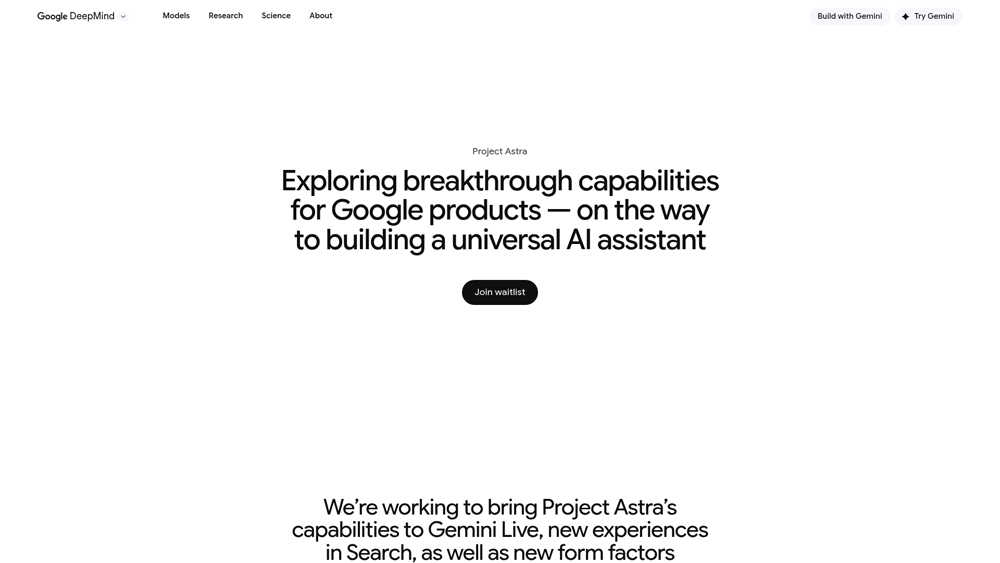
Project Astra is Google’s next-generation “universal agent” designed to perceive, reason, and respond to the physical world in real-time. Built on the Gemini family of models, Astra excels at multi-modal task automation by processing live video, audio, and text simultaneously. It is engineered to be a proactive assistant that remembers where you left your keys, explains complex code on your screen, or automates digital workflows across various applications with incredibly low latency.
In-Depth Review: Multi-Modal Context & Proactive Logic
Project Astra represents the culmination of Google DeepMind’s work in multi-modal reasoning. Unlike traditional chatbots that wait for a prompt, Astra is designed for continuous perception. We analyze its capacity to handle complex, multi-step automations—from identifying hardware components via a camera feed to executing API-based workflows in a browser. This agent doesn’t just talk; it observes and acts within your ecosystem.
Key Takeaways: Pros, Cons & Quick Summary
Our quick summary highlights how Astra moves beyond text to provide a truly ambient intelligence experience for users.
Key Advantages (Pros)
- Real-Time Perception: Processes live video feeds with almost zero latency for instant environmental feedback.
- Long-Term Spatial Memory: Remembers objects and locations across a session, allowing for “Where is my…?” queries.
- Cross-App Automation: Executes tasks across the Google Workspace and Android ecosystems with deep integration.
- Natural Voice Interaction: Features a highly expressive, human-like voice that understands nuance and interruption.
- Gemini 1.5 Pro Backbone: Leverages the massive 2M+ context window for complex, information-heavy projects.
Potential Drawbacks (Cons)
- Privacy Implications: Constant camera/mic access requires a high level of trust in Google’s data handling.
- Hardware Dependency: Optimal performance requires high-end mobile devices or specialized AR glasses.
- Ecosystem Lock-in: Works best within Google-supported apps, with fewer capabilities for third-party software.
Core Features: Ambient Intelligence & Visual Reasoning
Project Astra shifts the AI interaction model from a “Search” box to an “Eyes and Ears” experience. We focus on how this agent manages the transition from simple questions to complex automation tasks.
-
Visual QA & Debugging: Astra can look at a whiteboard of code or a broken mechanical part and provide immediate fixes, making it a powerful companion for engineers and technicians.
-
Proactive Reminders: Because Astra perceives your environment, it can remind you to take your umbrella if it sees rain outside or tell you where you set down your glasses ten minutes ago.
-
Unified Gemini Intelligence: By drawing from the Gemini 1.5 Pro model, Astra possesses the same high-level reasoning as the flagship chatbot but applies it to live, streaming data.
-
Low-Latency Voice Engine: The response time is tuned for natural conversation, effectively eliminating the awkward pauses found in earlier AI voice assistants.
-
Multi-Agent Orchestration: Astra can trigger other specialized Gemini agents to handle specific sub-tasks, such as booking a flight or organizing a spreadsheet, without leaving the visual interface.
The Future of Task Automation
The innovation in Project Astra lies in its ability to combine massive context with real-world sensor data. This creates a “universal” agent that is useful in both professional and personal spheres.
- Environmental Awareness: Astra understands spatial relationships, which is a massive leap forward for robotics and AR applications.
- Multimodal Streaming: The architecture allows for the simultaneous ingestion of video and audio, meaning it can “hear” a tone of voice while “seeing” a facial expression to gauge context better.
- Android Integration: As it rolls out to more devices, Astra is set to become the primary interface for the Android ecosystem, replacing traditional touch navigation for many tasks.
Performance, UX & Fluidity
Astra’s performance is judged by its “Fluidity”—the measure of how naturally it integrates into a human user’s life without causing friction or delay.
- Real-Time Responsiveness: The key differentiator is Astra’s speed. It identifies objects and responds to speech in less than a second, mirroring human-to-human interaction speeds.
- Contextual Continuity: Even if you move from one room to another, Astra maintains a coherent understanding of the task at hand, which is vital for complex automation.
- UX Simplicity: On a mobile device, the UX is centered around the camera view, with subtle AI overlays that provide information without cluttering the screen.
Project Astra Pricing & Value (2026)
Project Astra is largely being integrated into the Google One AI Premium subscription model. While basic visual search features are free, the full Agentic Automation and persistent memory features require a paid tier. Enterprise users can access Astra via Vertex AI for custom business automation.
FREE TIEREssential Search$0
- Price: $0/mo
- Models: Gemini Flash
- Visual: Basic Lens Search
- Best For: Occasional Help
WORKSPACEBusiness Logic$30
- Price: $30/user
- Compute: Priority Access
- Integration: Docs/Drive Autom.
- Best For: Small Teams
VERTEX AICustom AgentsUsage
- Price: Pay-Per-Token
- Privacy: Enterprise VPC
- Dev: Full API Access
- Best For: App Developers
Note: Project Astra features are being rolled out incrementally across Google Pixel devices and the Gemini app. Access to proactive “Smart Glasses” features or heavy API usage via Vertex AI may involve additional hardware costs or consumption-based billing. Always check your Google One subscription status for the latest feature unlocks.
Product Details
Project Astra is the leading framework for universal agentic interaction in 2026. It is the most capable tool for users who need an AI that can see their world and act on it, earning our highest recommendation for power users in the Android and Google ecosystems.
Platforms Supported
- Cloud
- Android
- ChromeOS
- Smart Glasses (Selected)
Training
- Google DeepMind Docs
Support
- Online / Community

Prompt Colleague Score
Quick Facts
- Company: Google DeepMind
- Released: 2024 (Beta)
- Core Tech: Gemini 1.5 Pro
- Best For: Real-time Task Automation
- Platform: Android / Smart Glasses
- Key Feature: Spatial Memory
- Official Site: deepmind.google
Pricing & Access
- Free Tier: Basic Visual Search
- AI Premium: $20 per month
- Enterprise: Vertex AI Usage
- Best Value: Google One AI Premium
Frequently Asked Questions (FAQ)
Gemini Live is the current consumer-facing interface for real-time voice chat. Project Astra is the advanced research framework that powers it, adding ‘eyes’ (continuous video perception), spatial memory, and agentic reasoning to complete tasks across your entire device and environment.
Astra uses a specialized ‘Episodic Memory’ system. As you move around with your phone or smart glasses, the model caches visual frames and recognizes objects. When you ask, “Where are my keys?”, it retrieves the last timestamp and location where they were visible in the camera’s field of view.
Astra’s core capabilities are rolling out through the Gemini app on Pixel 9, Samsung Galaxy S25, and newer flagship devices. Full ‘Universal Assistant’ features require hardware with dedicated AI processing units (like Tensor G4 or Snapdragon Gen 4) to maintain sub-300ms latency.
No. Astra is designed with ‘On-Device Privacy First’ principles. Most visual processing and wake-word detection happen locally on the device’s TPU. Data is only processed for reasoning when the assistant is active, and Google’s Application Layer Transport Security protects any cloud-based inference.
Yes, through ‘Agentic Tool Use.’ Astra can see what is on your screen and use Android’s accessibility layer or APIs to take actions, such as ‘finding that receipt in Gmail’ or ‘adding a specific item from a photo to my shopping list.’
Astra is ‘Native Multimodal.’ Unlike older assistants that convert voice-to-text then text-to-intent, Astra processes video and audio streams simultaneously in a single model (Gemini 2.5 Pro). This allows it to understand nuance, tone, and visual context in real-time without the ‘lag’ of traditional AI.
Project Astra: Universal AI APIs
Project Astra represents the shift from ‘Chatbots’ to ‘Actionable Agents.’ Through the Gemini Live API, developers can now access the Gemini 2.5 Pro multimodal backbone. This enables applications to ‘see’ through a user’s camera, ‘hear’ emotional context in real-time, and execute multi-step reasoning workflows. For enterprises, Astra provides the infrastructure for proactive support agents that can troubleshoot hardware by looking at it or manage complex logistics through a unified Workspace integration.
The API-first architecture of Astra allows for ‘Federated Learning’ and ‘Contextual Caching,’ reducing the computational overhead for real-time video processing. By utilizing Google’s global TPU v5 infrastructure, Astra-powered agents can maintain context across hours of interaction, making it the primary choice for industrial maintenance, real-time medical transcription, and personalized e-commerce style advisory.
Agentic Intelligence:
- Spatial Awareness (SLAM)
- Predictive Task Logic
- Cross-App Control
- Autonomous Browsing
- Multi-Language (24+)
- Real-Time Audio Fusion
- Workflow Orchestration
- Visual Object Tracking
- Hardware Interop (Glasses/Wearables)
- Intent Recognition
- Agentic Memory Graph
- Proactive Notifications
Visual & Audio Perception:
- Native Multimodal Encoding
- Object Identification (YOLOv9)
- Scene Graph Generation
- Document/OCR (LayoutLMv3)
- Emotion & Tone Detection
- Live Video Streaming (Sub-300ms)
- Spatial Audio Mapping
- Adaptive Noise Filtering
- Hand Gesture Recognition
- Real-time Face Landmarks
- Environment Depth Mapping
- Sync-Audio/Video Synthesis
Productivity & Workflow:
- Google Workspace Integration
- Automated Meeting Summaries
- Calendar Appointment Booking
- Gmail Draft Generation
- Travel Planning (Maps Sync)
- Cross-Document Reasoning
- Episodic Memory Retrieval
- Real-Time Code Debugging
- DIY Instruction Guidance
- Multi-Step Goal Planning
- Cloud TPU Acceleration
- Low-Latency Edge Processing
- Enterprise Data Compliance
Product Features In Detail:
As Google DeepMind’s vision for a universal assistant, Project Astra moves beyond simple question-and-answer exchanges. It acts as a continuous, context-aware partner that resides in your smartphone or wearables. This detailed feature breakdown explores how Astra utilizes Gemini 2.5 Pro to manage real-world tasks, maintain long-term memory, and provide proactive assistance without the friction of traditional app-switching. These capabilities are fundamental for users seeking a truly agentic AI experience.
Project Astra is built on a native multimodal transformer. Unlike models that stitch together separate vision and voice components, Astra processes live video and audio streams simultaneously. This allows it to understand complex environments—like identifying a broken part on a car engine while you’re describing the noise it makes—in under 300ms.
Astra solves the “where did I put that?” problem. By maintaining a temporal memory graph, it remembers where it saw specific objects in your environment. It can recall past visual events, allowing you to ask questions about things it ‘saw’ minutes or even days ago, creating a seamless sense of object permanence.
Astra doesn’t just talk; it acts. By integrating with the Gemini Live API and Android OS, it can perform multi-step tasks such as “Find my flight confirmation in Gmail and add the hotel location to my calendar.” It uses reasoning to determine which tools are needed to fulfill your request autonomously.
Rather than waiting for a prompt, Astra can offer proactive suggestions based on your surroundings. If you point your camera at a landmark, it can offer historical facts; if you’re looking at a restaurant menu, it can highlight dishes that fit your specific dietary preferences stored in its memory.
Astra utilizes WaveNet 3 and Google’s latest speech models to produce natural, emotionally aware dialogue. It can understand and replicate human intonation, making conversations feel more like a real-time partnership and less like a robotic transaction, even during interruptions.
To ensure speed and privacy, Astra uses a hybrid architecture. Edge TPUs handle immediate tasks like wake-word detection and basic object recognition locally, while Ironwood TPUs in the cloud power the high-level reasoning and complex multimodal fusion required for advanced tasks.
Astra was developed in collaboration with blind and low-vision communities. It can act as ‘AI eyes,’ describing scenes, reading text aloud from signs or screens, and providing real-time navigation guidance through audio, significantly increasing autonomy for users with visual impairments.
Operating within the Google Cloud and Workspace ecosystem, Astra adheres to strict security standards (SOC 2, ISO 42001). For enterprise users, data is protected by Application Layer Transport Security, and business-specific data is never used to train the public Gemini models.
The Top 4 AI Tools: Our Editors' Picks for Instant Productivity!
ChatGPT
AI Assistants
Google Gemini
AI Assistants

Midjourney
Image Generators
Otter.ai
Meeting Assistants