

Bubble Review 2026: The Premier No-Code Builder for OpenAI Applications
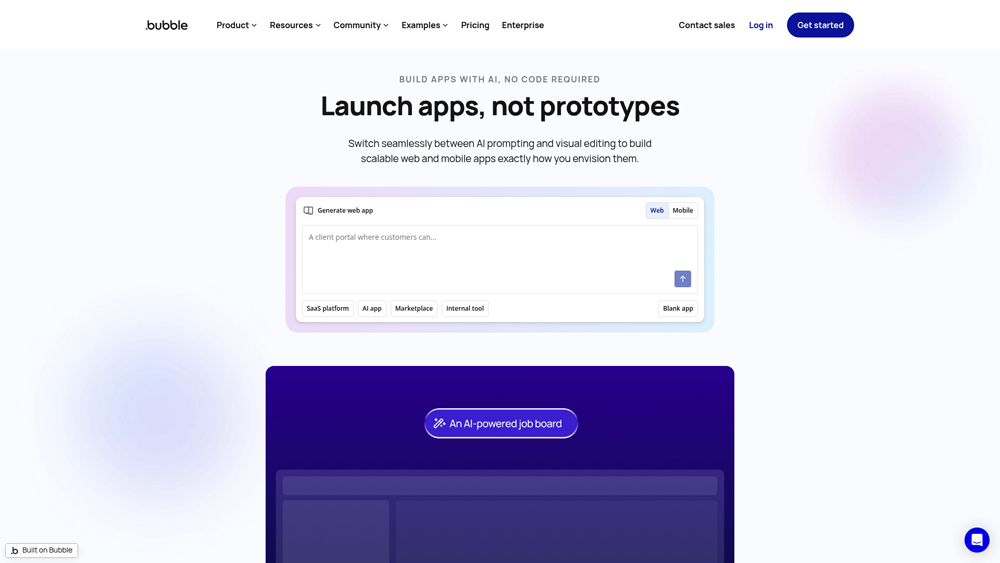
Bubble is a powerful visual programming platform that enables users to build full-stack web and mobile applications without writing code. By 2026, it has become the industry standard for “AI-first” development, thanks to its deep, native integration with the OpenAI API. Whether you are building a custom AI SaaS, an automated content engine, or a complex internal tool, Bubble provides the database, logic, and interface capabilities to turn OpenAI’s intelligence into a production-ready business application.
In-Depth Review & Model Analysis
Bubble’s evolution into an AI powerhouse is driven by its ability to act as a sophisticated “orchestrator” for OpenAI’s models. We evaluate its primary strengths across logic flexibility, API performance, and database integration, focusing on how it handles the high-demand requirements of modern AI startups.
Key Takeaways: Pros, Cons & Quick Summary
This summary highlights why Bubble is the top choice for AI builders, as well as the challenges users may face.
Key Advantages (Pros)
- Complete Logic Control: Build complex multi-step workflows that trigger OpenAI actions based on specific user data.
- Native API Connector: Direct, secure connection to GPT-4o, DALL-E 3, and Whisper with no middleware required.
- Scalable Infrastructure: AWS-backed hosting and a powerful built-in database that grows with your AI app.
- Mobile App Capabilities: Full support for building and publishing native iOS and Android apps with AI features.
- AI App Generator: Use natural language to generate initial app structures, reducing development time by 80%.
Potential Drawbacks (Cons)
- Steep Learning Curve: Mastering Bubble’s logic and responsive design requires a significant time investment.
- Workload-Based Pricing: High-frequency AI requests can quickly consume “Workload Units,” leading to higher costs.
- Vendor Lock-in: Apps built on Bubble cannot be easily exported to other platforms or raw code.
Core Features: GPT-4o Multi-Modal Mastery & Custom GPTs
Bubble offers a comprehensive environment where the OpenAI API isn’t just a plugin, it’s a fundamental building block of your application’s architecture.
-
The API Connector: The “command center” for your AI integration. It handles authentication and secure requests to OpenAI, allowing you to map AI responses directly to your app’s database fields.
-
Visual Workflow Engine: Create “If/Then” logic that feels like programming but looks like a flowchart. For example, “If a user’s sentiment is negative, send the text to OpenAI for a draft apology.”
-
AI-Ready Database: Store vast amounts of AI-generated content, user prompts, and metadata. Bubble supports complex data relationships, which is essential for building personalized AI assistants.
-
Real-Time Streaming: Bubble supports the “streaming” of text from OpenAI, so users see answers appear word-by-word, providing a premium, modern AI experience.
-
Responsive Design: The Flexbox-based editor ensures your AI tools look professional on desktop browsers and mobile devices alike.
Model Architecture & OpenAI Synergy
By leveraging the OpenAI API, Bubble apps gain access to the world’s most advanced reasoning capabilities without the need for a dedicated backend engineering team.
-
GPT-4o (Omni): The primary model used in most Bubble apps due to its extreme speed and multimodal capabilities (handling text, audio, and images in one call).
-
GPT-4o-mini: Perfect for high-volume, lower-complexity tasks where cost-efficiency is a priority. Bubble developers often swap between models dynamically to optimize performance.
-
Dynamic Context: Bubble allows you to “inject” any piece of data from your app user names, purchase history, or saved files—directly into your OpenAI prompts, making every AI interaction contextually aware.
Performance, Speed & User Experience (UX)
Performance is critical for AI apps. Bubble’s 2026 updates have drastically reduced the latency between an API call and the UI update.
-
Optimized API Latency: Bubble’s backend clusters are optimized for fast throughput, ensuring that your OpenAI calls don’t get bottlenecked at the platform level.
-
UX Design Flexibility: Unlike “boxed” AI builders, Bubble lets you design the exact interface your users need—whether it’s a sidebar assistant, a floating chat bubble, or a full-screen canvas editor.
-
Error Resilience: Built-in workflow error handling allows you to create “fallback” logic if an AI model is down or a request times out, maintaining a seamless user experience.
Bubble.io: 2026 No-Code Pricing & Power
The integration of Bubble and the OpenAI API represents the most efficient way to build “thinking” software today. With the ability to build, scale, and iterate without code, it remains the gold standard for entrepreneurs looking to lead the AI revolution.
STARTERMost Popular$32
- Price: $32/mo
- Model: 175k WUs/mo
- Core: Custom Domain Support Plus Recurring Backend Workflows and Basic Server Logs
- Best For: Individual Founders and Early Stage Prototyping for New AI Startups
TEAM PLANMost Popular$399
- Price: $399/mo
- Model: 500k WUs/mo
- Core: Five Collaborative Seats Plus Sub-App Functionality and Priority Server Power
- Best For: Full Product Agencies and Large Teams Building Complex Multi-Tenant SaaS
ENTERPRISEMost PopularCUSTOM
- Price: Custom
- Model: Uncapped WUs
- Core: Dedicated AWS Hosting Plus 24/7 Support and Database Storage Auto-Scaling
- Best For: Large Organizations and Mission Critical Systems Requiring Max Security
Note: Bubble pricing is primarily driven by Workload Units (WUs); complex backend recursions or heavy API integrations can quickly exhaust your plan’s monthly “fuel.” Professional apps with native iOS/Android deployment require the Mobile-supported tiers, and dedicated enterprise instances typically start at a custom $3,500/month rate. Always monitor your “App Metrics” dashboard for real-time consumption, as prices and WU-weighting for specific actions are subject to change by the platform.
Product Details
Bubble remains the gold standard for full-stack, no-code AI application development. It is the most versatile and scalable platform available, earning our highest recommendation for entrepreneurs and teams looking to build and launch custom AI SaaS products without writing traditional code.
Platforms Supported
- Web Browsers
- Progressive Web Apps
- Native iOS
- Native Android
Training
- Bubble Academy
- Interactive Bootcamps
- Video Documentation
- Certified Agency Partners
Support
- Email Support
- Community Forum
- Tiered Priority Support
- Status Page Updates

Prompt Colleague Score
Quick Facts
- Company: Bubble Group, Inc.
- HQ: New York, NY
- Best For: Full-Stack AI SaaS & Native Mobile
- Primary AI: Bubble AI Agent (Powered by GPT-5.1)
- Mobile Status: Native iOS/Android (via Bubble Mobile)
- Latest Feature: Data Type & Workflow Generation
- Official Site: bubble.io
Pricing & Access (2026)
- Free Plan: Build web & mobile (no launch)
- Starter (Web Only): $32/mo
- Starter (Web + Mobile): $59/mo
- Growth (Web + Mobile): $209/mo
- Workload Units: 175k (Starter) / 250k (Growth)
Frequently Asked Questions (FAQ)
No. Bubble is a visual programming language. You build the interface with drag-and-drop elements and define the AI logic using workflows. While it has a learning curve, it requires zero traditional coding knowledge to connect to OpenAI.
Yes, Bubble offers a robust free tier that allows you to access the full editor, build your database, and test your OpenAI API connections. You only need to upgrade to a paid plan when you are ready to launch on a custom domain.
Bubble connects to OpenAI via the API Connector. You will pay Bubble for the hosting/workload units, and you will pay OpenAI separately based on your token usage. Bubble does not take a cut of your OpenAI API spend.
Yes. By 2026, Bubble has introduced native mobile capabilities. You can build your AI app once and deploy it as a native application for iOS and Android, complete with push notifications and mobile-specific features.
Bubble is SOC 2 Type II compliant and offers secure environment variables. Your OpenAI API keys are stored server-side, meaning they are never exposed to the user’s browser, ensuring your intellectual property and data remain safe.
Workload Units are Bubble’s way of measuring resource usage. Each time your app sends a request to OpenAI or processes an AI response, it consumes WU. Optimized workflows can help keep these costs low even at scale.
Artificial Intelligence (AI) APIs
The true power of Bubble lies in its ability to orchestrate the OpenAI API ecosystem. By acting as the ‘brain’ behind the interface, Bubble allows developers to access GPT-4o, DALL-E 3, and Whisper to build multi-step autonomous reasoning and real-time multimodal processing directly into their apps.
This API-first approach is essential for businesses requiring massive context windows, secure data handling, and global scalability without the overhead of a traditional dev team.
Artificial Intelligence:
- Custom AI Chatbots
- AI for Healthcare SaaS
- AI Sales Assistants
- eCommerce Personalization
- Multi-Language Support
- Natural Language Processing
- AI-Driven Automation
- Virtual AI Agents
- DALL-E Image Integration
- Agentic Reasoning Workflows
- Multimodal AI Support
- Vector Database Connectivity
App Building Features:
- Visual Logic Engine
- Drag-and-Drop UI
- Sentiment Analysis Logs
- Dynamic Context Injection
- Real-time Database Updates
- API Orchestration
- Custom Plugin Marketplace
- Real-time Voice Streaming
- Predictive Modeling
- Autonomous App Scaling
- Built-in Analytics Dashboards
- Native Video Processing
Platform & Integration:
- OAuth2 Authentication
- Multi-Language Apps
- Custom Domain Hosting
- Stripe Payment Logic
- Version Control
- Server-side API Calls
- Recursive Workflows
- Bulk Data Operations
- SEO Meta Tag Control
- Database Privacy Rules
- Speech-to-Text Integration
- Text-to-Speech Integration
- Mobile Device Hardware Access
Product Features In Detail:
Beyond its visual editor, Bubble functions as a professional-grade development environment for AI applications. This section explores how the platform enables complex feature sets, from multimodal processing to enterprise security, allowing you to build AI tools that are indistinguishable from custom-coded software. Mastering these features is the key to scaling a successful AI startup in 2026.
The API Connector is Bubble’s most powerful feature for AI. It allows you to define exactly how your app talks to OpenAI, enabling you to use GPT-4o for logic, DALL-E for images, and Whisper for transcriptions, all within a single unified workflow.
Bubble’s logic engine acts as the ‘conductor.’ You can set up complex chains of events, such as: ‘When a user uploads a photo, send it to OpenAI for a description, then save that description to the database and email the user.’
For new projects, the AI App Generator allows you to describe your desired application in plain English. Bubble then generates the initial database structure, UI layout, and basic workflows, giving you a massive head start on development.
One of the most requested features for AI UX. Bubble supports the ‘streaming’ of text from OpenAI, so your users see the AI’s response being generated in real-time rather than waiting for the entire block of text to load.
Unlike other builders, Bubble includes a robust database. You can store user-specific AI memories, prompt histories, and multimodal data directly on the platform without needing an external service like Firebase or Airtable.
Turn your web-based AI tool into a native mobile app. Bubble handles the heavy lifting of responsive design and app store deployment, allowing you to reach users on any device with a consistent AI experience.
For enterprise AI apps, security is non-negotiable. Bubble’s ‘Privacy Rules’ ensure that sensitive AI data is only visible to the correct users, and the platform’s SOC 2 compliance provides the peace of mind needed for corporate clients.
If the native features aren’t enough, Bubble’s marketplace offers thousands of community-built plugins specifically for AI, including vector database connectors (Pinecone/Weaviate) and advanced PDF processing tools.
The Top 4 AI Tools: Our Editors' Picks for Instant Productivity!

ChatGPT
AI Assistants
Google Gemini
AI Assistants

Midjourney
Image Generators

Otter.ai
Meeting Assistants