

Vertex AI Review 2026: The Enterprise Benchmark for Machine Learning Operations
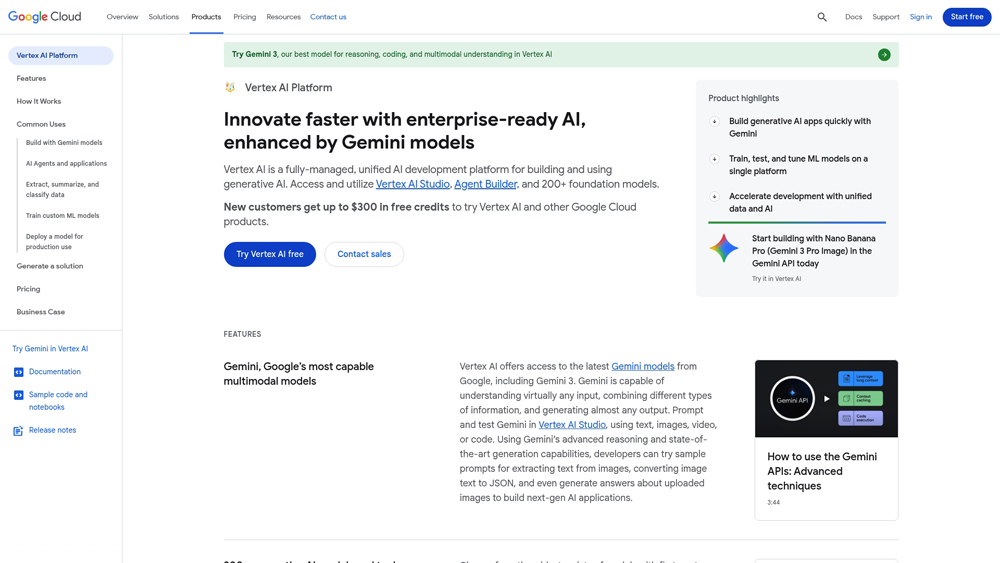
Google Cloud Vertex AI is a unified machine learning (ML) platform that allows developers and data scientists to build, deploy, and scale AI models faster. In 2026, it serves as a central hub for generative AI, combining data engineering, MLOps, and Google’s powerful Gemini models into a single integrated environment. Whether you are training custom models or utilizing foundation models via Model Garden, Vertex AI provides the infrastructure needed for production-grade artificial intelligence.
In-Depth Review & ML Architecture Analysis
Google Cloud Vertex AI has redefined the “ML Hub” by removing the silos between data preparation and model deployment. We evaluate its primary strengths across end-to-end MLOps, Model Garden variety, and integration with BigQuery. This analysis focuses on how Vertex AI handles the transition from experimental notebooks to high-availability production environments, particularly utilizing the latest Gemini 1.5 Pro and Flash architectures.
Key Takeaways: Pros, Cons & Quick Summary
This quick summary provides the core technical advantages and infrastructure drawbacks of adopting Vertex AI for enterprise-scale machine learning.
Key Advantages (Pros)
- Unified Data/AI Stack: Seamless integration with BigQuery and Cloud Storage for rapid training data access.
- Industry-Leading Model Garden: Access to Google’s Gemini, plus curated open-source models like Llama 3 and Claude.
- End-to-End MLOps: Sophisticated pipeline tools for versioning, monitoring, and auto-scaling production models.
- Advanced Generative AI Studio: Low-code tools for prompt engineering, tuning, and deploying AI agents quickly.
- TPU & GPU Acceleration: Native access to custom Google silicon (TPUs) for high-performance training at scale.
Potential Drawbacks (Cons)
- Steep Learning Curve: The sheer number of features can be overwhelming for beginners or non-GCP users.
- Complex Pricing: Billing is fragmented across compute, storage, and API calls, requiring careful oversight.
- Ecosystem Lock-in: Best features are optimized for GCP, making multi-cloud strategies more difficult to manage.
Core Features: Gemini 1.5 Integration & Model Garden
Vertex AI offers a comprehensive developer suite that bridges the gap between research and deployment. We focus on the features most vital for ML engineers, including automated pipelines, model monitoring, and the groundbreaking context windows of the Gemini family.
-
Model Garden & Model Registry: A centralized library where developers can discover and deploy a wide variety of foundation models, from Google’s proprietary Gemini to open-source alternatives like Mistral.
-
Vertex AI Pipelines: Orchestrate serverless ML workflows using Kubeflow or TFX to automate the training, evaluation, and deployment of complex model architectures.
-
Generative AI Studio: A dedicated environment for prompt tuning, where developers can fine-tune Gemini models on proprietary data without writing extensive boilerplate code.
-
BigQuery ML Integration: Allows data analysts to create and execute machine learning models in BigQuery using standard SQL, democratizing AI across the organization.
-
Continuous Monitoring & Evaluation: Built-in tools to detect model drift, analyze performance, and ensure that deployed AI agents remain accurate and safe over time.
Hardware Acceleration & Performance Infrastructure
The performance of Vertex AI is anchored by Google’s global infrastructure. Leveraging custom-built hardware like Tensor Processing Units (TPUs) provides a distinct advantage for training massive datasets.
- TPU v5p & NVIDIA H100s: Vertex AI provides high-speed access to the world’s most powerful AI chips, enabling training times to be cut from weeks to hours for large-scale language models.
- Gemini 1.5 Pro Context: The platform supports the massive 2-million token context window, allowing developers to process entire codebases or hours of video in a single prompt.
- AutoML Capabilities: For teams without deep ML expertise, Vertex AI’s AutoML can automatically find the best model architecture and hyper-parameters for a specific dataset.
Developer Experience & API Management
Vertex AI is designed for professional developers who require robust SDKs, API security, and granular access controls through IAM (Identity and Access Management).
- Unified SDK: The Vertex AI SDK for Python provides a clean, consistent way to interact with all services, from data ingestion to model deployment, via a single library.
- Vertex AI Workbench: A managed Jupyter notebook environment that comes pre-installed with all necessary ML frameworks (TensorFlow, PyTorch, Scikit-learn), ready for immediate experimentation.
- Grounding with Search: A critical enterprise feature that allows developers to “ground” Gemini’s answers in real-time Google Search data or their own internal corporate documents to prevent hallucinations.
Vertex AI Pricing & Production Value
Vertex AI operates on a Consumption-Based model. In 2026, Google has simplified this into four primary pillars. While the Free Tier provides $300 in credits to start, the real value lies in the Flash models for high-speed tasks and Provisioned Throughput for enterprise-grade reliability. Note that pricing is now split by context length, with a premium for prompts over 200k tokens.
FLASHSpeed & Efficiency$0.10
- Cost: Per 1M Input Tokens
- Output: $0.40 / 1M Tokens
- Best For: Chatbots & Summaries
- Context: 1M Token Window
ULTRA / G3State-of-the-Art$2.00
- Cost: Per 1M Input Tokens
- Output: $12.00 / 1M Tokens
- Best For: Multimodal Reasoning
- Feature: Video/Audio Native
ENTERPRISEScale & SecurityCustom
- Resource: Provisioned Throughput
- Support: 24/7 Premium
- Security: VPC Service Controls
- Discount: Volume-based tiers
PRO TIP: Watch out for the context “Cliff.” In 2026, if your prompt exceeds 200,000 tokens, the price per million tokens doubles for Pro and Ultra models; visitors should always check the official Vertex AI site for the most current prices and specific model rates. Use Context Caching ($0.01 – $0.20 per 1M tokens/hour) to store large documents or codebases frequently accessed by your AI—it can save you up to 90% on repetitive input costs.
Production Value: The Multimodal Advantage
In 2026, Vertex AI’s production value is defined by Native Multimodality. Unlike models that “translate” images into text before processing, Gemini 2.5 and 3 process video and audio directly. This allows for features like Real-time Video Q&A and Advanced Document Understanding (reading charts, handwriting, and layout simultaneously). The Vertex AI Agent Builder has also been upgraded with Stateful Memory, meaning your agents can maintain context over weeks of interaction, making them feel like true digital employees rather than simple session-based bots. This is the ultimate “Production Grade” platform for businesses that need to scale AI without the infrastructure headache.
Platforms Supported
- Google Cloud Console
- Vertex AI SDK (Python/Node)
- REST API
- gcloud CLI
- Terraform Integration
Training
- Google Cloud Skills Boost
- Extensive Documentation
- Sample Notebook Library
Support
- 24/7 Enterprise Support
- Community Forums
- Premium Account Managers

Prompt Colleague Score
Quick Facts
- Provider: Google Cloud Platform
- Core Model: Gemini 2.0 (Ultra/Flash)
- Best For: Scalable Enterprise GenAI
- Innovation: Vertex AI Agent Builder
- Compute: TPU v5p & NVIDIA H200s
- Free Tier: $300 Credit (New Users)
- Official Site: cloud.google.com
Pricing & Access (2026)
- Pay-As-You-Go: Per 1M Tokens
- Provisioned: Fixed Throughput
- AutoML Tier: Per Node/Hour
- Enterprise: Commitment Discounts
- Best Value: Gemini 2.0 Flash (API)
Frequently Asked Questions (FAQ)
Gemini 1.5 Pro is the high-intelligence model optimized for complex reasoning and massive context (up to 2M tokens). Gemini 1.5 Flash is a lightweight, high-speed model designed for high-frequency tasks and low-latency applications, making it more cost-effective for large-scale deployments.
By default, Google Cloud does not use customer data submitted to Vertex AI to train its foundation models. Vertex AI provides enterprise-grade security with VPC Service Controls, Customer-Managed Encryption Keys (CMEK), and IAM integration to ensure complete data sovereignty.
The Model Garden is a curated repository within Vertex AI that allows developers to discover, test, and deploy a wide range of models. This includes Google’s first-party models (Gemini, Imagen, Chirp), open-source models (Llama 3, Mistral, Gemma), and third-party models like Claude 3.5.
Yes, Vertex AI supports multiple tuning methods including supervised fine-tuning and Reinforcement Learning from Human Feedback (RLHF). You can use the Generative AI Studio for low-code tuning or use custom training pipelines for deeper model architectural adjustments.
Vertex AI integrates natively with BigQuery ML, allowing data scientists to build and deploy models using SQL. You can also use BigQuery as a data source for training models or for grounding LLM responses in real-time structured enterprise data.
Absolutely. Vertex AI Pipelines allows you to automate and monitor ML workflows. With the Vertex AI Model Registry and Monitoring tools, you can manage the entire lifecycle of a model from experimentation to automated deployment and drift detection.
Vertex AI Developer Hub & ML APIs
The professional utility of Vertex AI is centered on its robust API-first architecture. In 2026, the Vertex AI API provides programmatic access to the Gemini 1.5 ecosystem, enabling developers to build agentic workflows that can process up to 2 million tokens of context. This infrastructure is purpose-built for enterprise-grade applications requiring massive data ingestion, multi-modal reasoning, and high-concurrency performance across Google’s global cloud regions.
Developers utilize Vertex AI endpoints to integrate advanced NLP, computer vision, and predictive analytics into existing enterprise software. By leveraging Google’s TPU (Tensor Processing Unit) clusters, the API offers unmatched throughput for training and inference, ensuring that internal systems like recommendation engines, fraud detection units, and automated support agents operate with maximum efficiency and security.
Machine Learning & Infrastructure:
- AutoML for Vision/Tabular
- For Predictive Analytics
- For Supply Chain AI
- For Financial Fraud Detection
- TPU/GPU Acceleration
- Distributed Training
- Serverless ML Pipelines
- Vector Search (Matching Engine)
- Cloud TPU v5p Support
- Enterprise Agentic Workflows
- Unified Metadata Tracking
- Custom Model Serving
MLOps & Model Management:
- Feature Store
- Model Monitoring
- Drift Detection
- Lineage Tracking
- A/B Testing Endpoints
- Hyperparameter Tuning
- Explainable AI (XAI)
- Batch Prediction Services
- CI/CD for ML
- Kubeflow Integration
- Artifact Registry
- Model Checkpointing
Generative AI & LLM Tools:
- Prompt Engineering Studio
- RLHF Tuning
- Adapter Tuning (LoRA)
- Response Grounding
- Safety Filter Customization
- Agent Builder
- 2M Token Context Window
- Multi-modal Video Analysis
- RAG Infrastructure
- Enterprise Search Integration
- Speech-to-Text API
- Text-to-Speech API
- Visual Q&A Models
Data Science & Engineering:
- Managed Notebooks
- BigQuery Integration
- Dataproc Integration
- Pandas/Scikit-learn Support
- TensorFlow/PyTorch Native
- Custom Container Serving
- Automatic Scaling
- IAM Governance
Natural Language Processing (NLP) Core:
- Entity Extraction
- Syntax Analysis
- Sentiment Analysis
- Context-Aware Embeddings
- Semantic Search
- Neural Machine Translation
- Custom Vocabulary Training
- Topic Modeling
- Multilingual Support
- Named Entity Recognition (NER)
Product Features In Detail:
Beyond its model hosting capabilities, Vertex AI functions as an end-to-end ecosystem for production Machine Learning. This detailed breakdown demonstrates how developers and data scientists leverage Google’s infrastructure for tasks including model orchestration, automated data labeling, real-time inference, and MLOps scaling. These capabilities are essential for organizations moving from basic AI experimentation to robust, high-availability deployments.
A comprehensive interface to discover and deploy foundational, open-source, and third-party models. It streamlines the testing of Gemini 1.5, Llama, and Claude models within a single managed infrastructure, reducing deployment friction.
A single interface for the entire data science workflow. It provides managed Jupyter notebooks that are natively integrated with BigQuery, Dataproc, and Spark, allowing for seamless data exploration and model development.
A low-code environment specifically for prototyping and testing generative AI. Developers can quickly experiment with prompt templates, adjust model parameters, and ground responses using Google Search or private datasets.
The industry’s leading high-scale vector database service. It enables high-speed, low-latency similarity searches across billions of vectors, a critical component for building Retrieval-Augmented Generation (RAG) applications.
Vertex AI Pipelines helps you automate your ML system by orchestrating your ML workflows using Kubeflow or TFX. This ensures reproducible and scalable model training and deployment processes for enterprise teams.
For teams with limited data science expertise, AutoML allows for the creation of high-quality custom models for image, video, text, and tabular data without writing a single line of training code.
A sophisticated feature that minimizes hallucinations by connecting LLMs to live, verified data sources. You can ground Gemini’s responses in internal document repositories or real-time Google Search results.
Vertex AI provides native access to Google’s proprietary Cloud TPUs. These chips are specifically designed for the heavy mathematical loads of AI training, providing significantly faster performance than traditional hardware for large models.
The Top 4 AI Tools: Our Editors' Picks for Instant Productivity!
ChatGPT
AI Assistants
Google Gemini
AI Assistants

Midjourney
Image Generators
Otter.ai
Meeting Assistants