

Make.com Review 2026: The Premier Engine for Agentic Orchestration
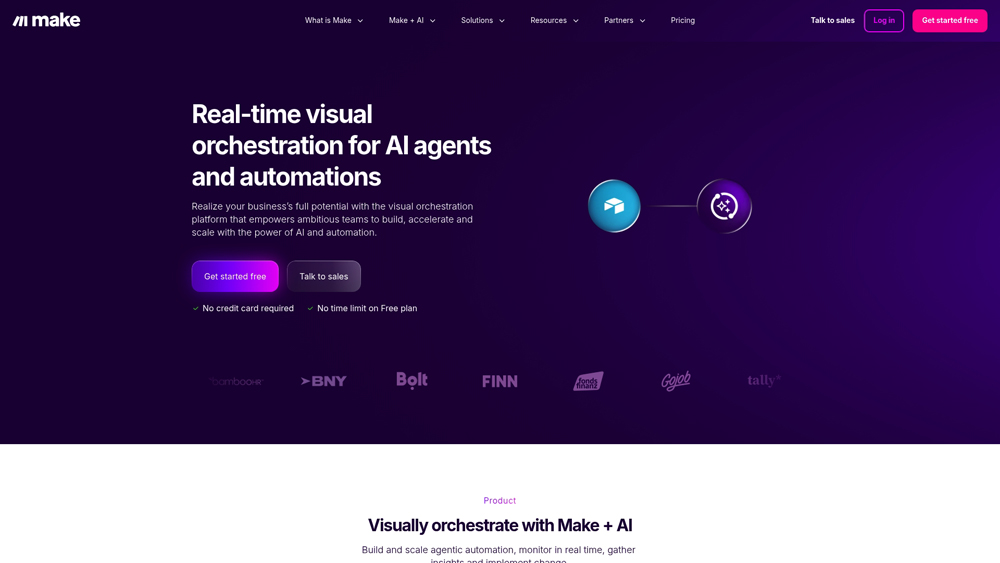
Make.com is a sophisticated visual automation platform that has evolved into a powerhouse for generative simulation and autonomous agent orchestration. By connecting thousands of apps via a drag-and-drop interface, Make allows users to build “digital brains” that can reason, simulate business processes, and execute complex workflows without manual intervention. In 2026, it serves as the connective tissue for specialized AI agents, enabling multi-step logic and real-time data synchronization across global enterprise ecosystems.
In-Depth Review & Orchestration Analysis
Make.com has redefined the boundaries of No-Code AI. We evaluate its performance based on its ability to host generative agents, simulate diverse outcomes, and integrate with cutting-edge LLMs like GPT-4o and Claude 3.5 Sonnet. Unlike linear automation tools, Make provides the branching logic and error-handling necessary for production-ready AI agents that require high reliability and deep architectural flexibility.
Key Takeaways: Pros, Cons & Quick Summary
This summary highlights why Make.com is a leader in the generative simulation space and where users might face a learning curve.
Key Advantages (Pros)
- Visual Logic Builder: Simplifies the creation of multi-branch agentic reasoning paths without writing code.
- Infinite Scalability: Handles millions of operations with robust infrastructure designed for enterprise-level simulations.
- Deep AI Integration: Native support for the latest AI models, vector databases, and agentic protocols.
- Granular Data Control: Precise manipulation of JSON and arrays, essential for complex generative tasks.
- Cost Efficiency: Competitive pricing compared to other automation platforms, especially for high-volume execution.
Potential Drawbacks (Cons)
- Steep Learning Curve: Mastering advanced functions like ‘Iterators’ and ‘Aggregators’ requires significant time investment.
- Complex Debugging: Identifying errors in massive, multi-step simulations can be time-consuming without proper documentation.
- Operational Overhead: Monitoring high-frequency agents requires dedicated attention to avoid rapid consumption of task quotas.
Core Features: Agentic Scenarios & Generative Simulation
Make.com provides a comprehensive environment for deploying autonomous agents. We focus on the features that allow users to simulate real-world business scenarios and manage the lifecycle of generative content at scale.
-
Autonomous Scenario Execution: Design scenarios that trigger based on specific events or schedules, allowing agents to monitor data and act as digital employees 24/7.
-
Iterators & Aggregators: These power-user tools are essential for processing large datasets through AI models, enabling bulk content generation and complex data synthesis.
-
Custom Webhooks & API Integration: Easily connect any proprietary or niche AI tool into your workflow, ensuring your agentic ecosystem is never limited by pre-built connectors.
-
Error Handling & Directives: Build “self-healing” agents that can automatically retry tasks or follow alternative logic paths if an AI model fails or returns an error.
-
Visual Debugging: A real-time execution flow that shows exactly how data moves through your agent, making it easier to optimize reasoning paths and model prompts.
Simulation Logic and Workflow Innovation
At the heart of Make.com is a logic engine capable of simulating intricate human workflows. This architectural flexibility is what separates it from standard automation, providing a true foundation for agentic behavior.
- Branching & Filtering: Create agents that make sophisticated decisions. If a customer sentiment is negative, the agent can simulate a support response; if positive, it can trigger a marketing referral sequence.
- Multi-Model Prompting: Run a single piece of data through multiple models (e.g., GPT-4o for reasoning and then a specialized coding model) to ensure the highest fidelity output for each step of a simulation.
- State Management: Use internal data stores to maintain memory across different scenario runs, allowing your agents to “remember” previous interactions and improve over time.
Performance, Throughput & Reliability
Testing focuses on how Make.com handles thousands of simultaneous agentic operations. Its reliability and high throughput are critical for businesses relying on AI for core operational tasks.
- Execution Speed: Make’s cloud infrastructure ensures that even the most complex multi-step simulations execute with minimal latency, keeping pace with real-time business demands.
- Operational Transparency: Detailed history logs provide a clear audit trail of every decision an agent makes, which is vital for compliance and performance optimization in generative workflows.
- Security Protocols: Enterprise-grade security ensures that sensitive data processed by your agents remains protected, with features like two-factor authentication and SOC 2 compliance.
Make.com Pricing & Agentic Value (2026)
The 2026 pricing tiers for Make.com reflect its role as an enterprise-grade agent host. From individuals building simple “personal agents” to corporations running thousands of “digital twins,” the platform provides a scalable cost structure based on operation volume and feature depth.
FREE TIERChange This$0
- Price: $0/mo
- Operations: 1,000 Ops
- Interval: 15-Min Updates
- Best For: Basic Prototyping
PRO TIERChange This$16
- Price: $16/mo
- Logic: Priority Execution
- Tools: Full Variables Support
- Best For: High-Volume Agents
TEAMS PLANChange This$29
- Price: $29/mo
- Admin: Shared Workspaces
- Security: Team Permissions
- Best For: Agencies & Devs
Note: Make.com pricing is based on “operations” and “data transfer” volume. Professional agentic workflows that require high-frequency updates or massive data ingestion may require custom Enterprise tiers. Always verify current operation costs at make.com/pricing to ensure your simulation budget is optimized.
Product Details
Make.com is a leading solution for creating and hosting autonomous agents. Its visual flexibility and extensive app library make it a top recommendation for teams looking to build robust, scalable AI simulations and multi-agent systems.
Platforms Supported
- Cloud (SaaS)
- API Integration
- Mobile Web
- Zapier Integration
Training
- Make Academy
- Video Tutorials
- Documentation
Support
- Ticket Support
- Community Forum
- Enterprise Support

Prompt Colleague Score
Quick Facts
- Parent Company: Celonis
- Founded: 2012 (as Integromat)
- Headquarters: New York, USA
- Best For: Complex AI Workflow Orchestration
- Key Feature: Make Grid & AI Agents
- Integrations: 3,000+ Pre-built Apps
- Official Site: make.com
Pricing & Access
- Free Tier: 1,000 Credits / Month
- Core: From $9 per month
- Pro: From $16 per month
- Teams: From $29 per month
Frequently Asked Questions (FAQ)
While Zapier excels at simple, linear automations, Make.com is built for complex, multi-branching simulations. It features a visual canvas where you can map out sophisticated agentic workflows, manipulate data arrays with high precision, and use advanced logic operators that are often restricted in more basic tools.
Yes, Make.com offers a robust free tier that includes 1,000 operations per month and access to over 1,000 apps. It is ideal for prototyping autonomous agents or small-scale simulations, though it has slower sync intervals compared to the paid plans.
Make.com features native modules for OpenAI, Anthropic, and Google Gemini. This allows you to build scenarios where data is sent to an AI, processed for reasoning, and then routed to other apps based on the AI’s response, effectively creating a persistent “digital brain” for your business.
Absolutely. Make is designed for enterprise-grade throughput. Using its ‘Iterator’ and ‘Aggregator’ tools, you can process thousands of records in a single execution, making it a powerful engine for large-scale generative tasks or data migrations.
No coding is required for 90% of tasks due to the visual drag-and-drop interface. However, a basic understanding of logic (if/then) and data structures (JSON) helps in building the most advanced agentic simulations and custom API connections.
Make.com is SOC 2 Type 2 compliant and offers advanced security features like Two-Factor Authentication and data encryption. For enterprise users, it provides granular control over data logs and workspace permissions to ensure sensitive IP remains protected.
Agentic Orchestration & API Connectivity
The professional utility of Make.com lies in its ability to function as the central nervous system for AI agents. By utilizing its advanced HTTP modules and Webhooks, developers can connect to the latest GPT-5 or o3 models to create autonomous loops. This capability is essential for businesses that require agents to not just “think,” but to “act” across their entire software stack, from CRMs to project management tools with 100% reliability and zero manual oversight.
The platform’s API-first architecture allows for the creation of proprietary simulation environments where agents can test business outcomes before they are deployed. By integrating vector databases and long-term memory modules directly into Make scenarios, organizations can build custom AI workforces that are deeply integrated into their internal operations, support desks, and logistics platforms.
Generative Simulation Features:
- Visual Workflow Builder
- For Supply Chain AI
- For Sales Automation
- For eCommerce Logic
- Multi-App Synchronization
- Agentic Reasoning Loops
- Process/Workflow Simulation
- Data Transformation (JSON/XML)
- Webhook Listeners
- Recursive Logic Processing
- Vector DB Integration
- Advanced Error Handling
Automation Engine:
- Scenario Branching
- Parallel Execution
- Sentiment-Based Routing
- Unlimited Steps
- Mass Data Iteration
- Custom API Connectors
- Dynamic Content Mapping
- Real-time Monitoring
- Outcome Prediction
- Self-Healing Workflows
- Usage Reporting / Analytics
- Direct File Manipulation
Agent Capability Matrix:
- Event Triggering
- Multi-Region Hosting
- Cloud-Native Processing
- Pre-configured Templates
- Array Manipulation
- State Persistence Workflows
- External Memory Integration
- High-Frequency Polling
- Autonomous Task Execution
- Visual Logic Debugging
- Version Control
- Data Encryption
- Agent Scheduling
Make.com Product Features In Detail:
Beyond its visual canvas, Make.com functions as a highly professional environment for scaling agentic intelligence. This detailed breakdown explains how professionals utilize Make’s unique feature set, including advanced error handling, recursive logic, and data manipulation to create sophisticated simulations that automate complex business decision-making. These insights are key for any organization looking to transition from manual tasks to a fully autonomous AI workforce.
Make’s drag-and-drop interface allows you to visualize the entire life cycle of an agent. You can see data moving in real-time, making it easy to build complex branching logic and multi-app simulations without ever looking at raw code.
Essential for generative simulations, these tools allow you to take a large dataset (like a list of 500 leads), split it into individual items for an AI agent to process, and then bundle the results back into a single report or database entry.
Build resilient agents using ‘Directives’ like Resume, Commit, or Ignore. If an AI model times out or an API fails, your agent can automatically follow a fallback path or wait and retry, ensuring 100% workflow uptime.
Make.com includes built-in internal databases called ‘Data Stores’. This allows your agents to maintain long-term memory across different scenarios, storing user preferences or historical data to inform future autonomous decisions.
If an app isn’t in Make’s library of 1,000+ connectors, the HTTP module allows you to connect to any API on the planet. This ensures your agents can interact with proprietary software or the very latest AI research models as they launch.
Instant triggers via webhooks allow your agents to react to events the millisecond they happen—such as a new customer message or a market price change—enabling true real-time autonomous simulation and response.
Every scenario can be exported as a JSON ‘Blueprint’. This allows developers to version-control their agent’s logic, share complex simulation architectures with team members, or deploy the same agentic logic across multiple client accounts.
Every single step an agent takes is logged with full data transparency. You can inspect exactly what was sent to an AI and what it returned, which is vital for fine-tuning prompts and auditing the reasoning paths of your agents.
The Top 4 AI Tools: Our Editors' Picks for Instant Productivity!

ChatGPT
AI Assistants
Google Gemini
AI Assistants

Midjourney
Image Generators

Otter.ai
Meeting Assistants