

Microsoft AutoGen Review 2026: Leading Multi-Agent Orchestration
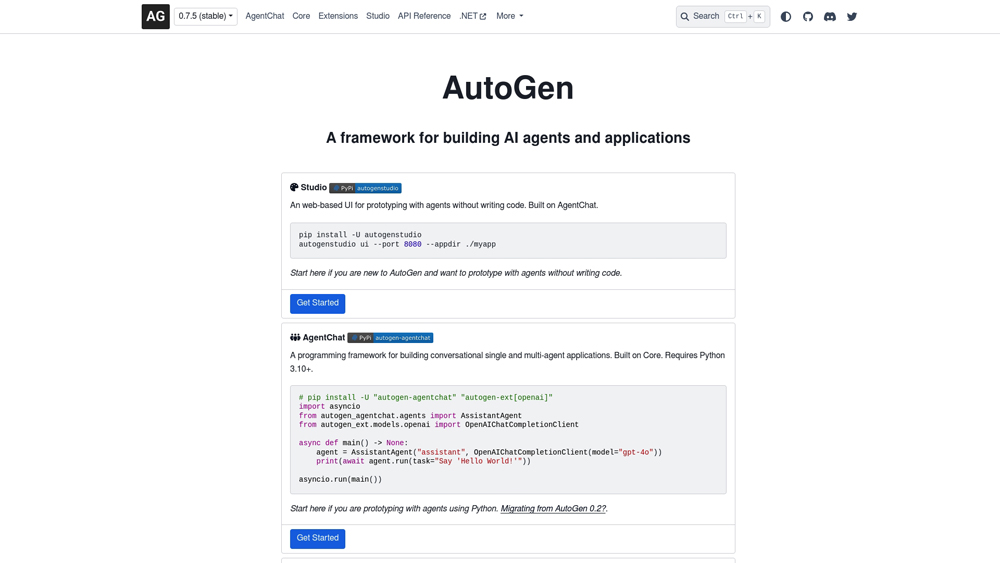
Microsoft AutoGen is an advanced open-source framework designed to simplify the orchestration, optimization, and automation of multi-agent LLM workflows. By enabling multiple AI agents to converse with one another, it solves complex problems that a single LLM cannot handle alone. Developers use AutoGen to build autonomous systems where agents take on specialized roles such as coders, reviewers, and planners to execute intricate tasks with minimal human intervention. It supports diverse conversation patterns and integrates seamlessly with various LLM providers and local models.
In-Depth Framework Analysis
Microsoft AutoGen has redefined the landscape of task automation agents. We evaluate its primary strengths across developer flexibility, multi-agent logic, and framework reliability, focusing on how its customizable conversation patterns allow for sophisticated enterprise-grade automation. This analysis examines its capacity to maintain state and logic across complex, non-linear tasks.
Key Takeaways: Pros, Cons & Quick Summary
This quick summary highlights the core technical advantages and implementation challenges when deploying Microsoft AutoGen for professional automation projects.
Key Advantages (Pros)
- Sophisticated Agent Logic: Supports complex multi-agent conversations that can autonomously solve coding and research tasks.
- High Customizability: Provides granular control over agent personas, tool usage, and interaction patterns.
- Code Execution Sandbox: Native support for safe code execution, allowing agents to test and refine their own scripts.
- Extensible Framework: Easily integrates with proprietary APIs and various LLM backends including GPT-4 and local models.
- Open-Source Community: Rapid development cycle with frequent updates and a large repository of pre-built agent examples.
Potential Drawbacks (Cons)
- Steep Learning Curve: Requires significant Python knowledge and understanding of agentic design patterns to implement effectively.
- Token Consumption: Multi-agent dialogues can quickly escalate API costs due to frequent back-and-forth communication.
- Orchestration Complexity: Managing state and avoiding “infinite loops” in agent conversations requires careful prompt engineering.
Core Features: Multi-Agent Conversations & Custom Skills
AutoGen offers a specialized suite of features designed for the next era of autonomous software. We focus on the capabilities that enable developers to move beyond static chains into dynamic, conversational task execution.
-
Multi-Agent Conversation Framework: The core innovation allows agents to communicate using natural language, enabling collaborative problem-solving between diverse AI specialists.
-
Human-in-the-Loop Integration: Provides built-in mechanisms for humans to provide feedback or oversight at specific steps, ensuring safety and accuracy in critical workflows.
-
Custom Skill Development: Developers can equip agents with “skills”—reusable Python functions—that allow agents to interact with the web, databases, or local filesystems.
-
Diverse Conversation Patterns: Supports various interaction styles, including joint chat, hierarchical delegation, and dynamic group chats where an agent manager routes tasks.
-
Enhanced Code Interpretation: Agents can write, execute, and debug code in a secure environment, making it highly effective for data science and software engineering automation.
System Architecture and Agentic Innovation
Understanding the AutoGen architecture is key to building reliable automation. The framework’s innovation lies in its ability to manage complex state transitions and maintain logic throughout an agentic interaction.
- ConversableAgent Class: The foundational building block that can send/receive messages and trigger actions, allowing for a uniform way to handle different LLM behaviors.
- Group Chat Manager: A specialized agent that orchestrates group discussions, deciding which agent should speak next based on the task context and agent descriptions.
- Error Awareness: AutoGen agents can be prompted to recognize execution errors and re-attempt tasks, simulating a human-like troubleshooting process for software deployment.
Scalability, Performance & Developer Experience (DX)
Developer experience testing focuses on the ease of implementation, the clarity of the API, and the robustness of the agent orchestration under heavy task loads.
- Orchestration Reliability: AutoGen provides high consistency in routing tasks, though the quality of the final output remains dependent on the underlying LLM’s reasoning capabilities.
- Local Execution Support: Unlike purely cloud-based tools, AutoGen allows for local hosting of both the framework and the models, providing a high degree of control over the execution environment.
- Debugging & Logging: The framework offers detailed logs of agent-to-agent communication, which is essential for identifying where logic breaks down in multi-step automations.
AutoGen Access & Implementation Value (2026)
Microsoft AutoGen is primarily an Open Source framework, but in 2026, the cost landscape has evolved into four distinct implementation tiers. While the library remains free, the “price” of a professional deployment is defined by your orchestration layer, security needs, and token throughput.
COMMUNITYSelf-Hosted / Local$0
- Price: $0 (Library)
- Usage: Unlimited Local Run
- Models: Local (Ollama/Llama)
- Best For: R&D & Tinkering
DEVELOPER PROCloud Orchestration$49
- Price: Per Month / User
- Features: Managed Studio UI
- Access: Advanced Tracing
- Best For: Freelance Devs
ENTERPRISEFull Sovereign AICUSTOM
- Price: Custom Annual
- Compute: Private Instances
- Support: 24/7 MS Support
- Best For: Global Orgs
Note: In 2026, Microsoft has integrated AutoGen into the ‘Microsoft Agent Framework.’ While the open-source SDK remains free, using managed Azure features or hosted Agent Studio interfaces will incur costs. Always monitor your LLM token burn, as autonomous agents can engage in multi-turn reasoning that scales costs rapidly.
Product Details
Microsoft AutoGen remains the definitive framework for multi-agent automation in 2026. By evolving from a simple library into a managed orchestration layer within the Microsoft ecosystem, it allows developers to build self-correcting AI teams with enterprise-grade security and observability.
Platforms Supported
- Linux
- Windows
- Mac
- Azure Cloud
- Docker Sandbox
Training
- Technical Documentation
- GitHub Samples
Support
- Community Forum
- GitHub Issues

Prompt Colleague Score
Quick Facts
- Company: Microsoft
- Released: 2023
- License: MIT
- Best For: Multi-Agent Workflows
- Programming: Python / .NET
- Cloud Support: Azure AI Studio
- Official Site: microsoft.github.io
Pricing & Access
- Library: Free (Open Source)
- Hosting: Azure Pay-as-you-go
- LLM Costs: API dependent
- Best Value: Self-hosted
Microsoft AutoGen: Frequently Asked Questions (FAQ)
Microsoft AutoGen is an open-source framework that allows developers to create “agentic” workflows. Unlike a single chatbot, AutoGen enables multiple AI agents to talk to each other to solve a task. For example, one agent can write code while another agent reviews and executes it, working together until the goal is achieved.
The AutoGen library itself is free and open-source (MIT License). However, you are responsible for the costs of the LLMs you connect to it. If you use OpenAI’s GPT-4o or Azure OpenAI services, you will be billed based on your token consumption. Local models (via Ollama or LM Studio) can be used for a completely free execution environment.
Yes, AutoGen is primarily a developer-centric tool. While there are low-code interfaces emerging (like AutoGen Studio), a solid understanding of Python is required to build customized agents, define complex interaction patterns, and integrate proprietary tools or databases.
AutoGen features a built-in Docker executor, which is the recommended way to run agent-generated code. This creates a “sandbox” that keeps your host system safe. It also supports human-in-the-loop (HITL), allowing you to approve every line of code before it is executed.
Absolutely. AutoGen is model-agnostic. You can use any model that supports an OpenAI-compatible API, including Anthropic Claude, Google Gemini, or local open-source models like Llama 3 and Mistral. You can even have different agents in the same “crew” using different models to optimize for cost and performance.
While both are multi-agent frameworks, AutoGen focuses heavily on conversational patterns and dynamic delegation. It is often seen as more flexible for non-linear, unpredictable tasks where agents need to iterate back and forth, whereas CrewAI is often preferred for role-based, process-driven sequential workflows.
The Agentic Ecosystem & Orchestration APIs
The architectural shift in 2026 has moved from single-prompt interactions to multi-agent orchestration. Microsoft AutoGen sits at the center of this revolution, providing the programmatic “glue” that connects specialized LLMs into a high-functioning digital workforce. By utilizing Azure AI Studio or local Python environments, developers can now deploy autonomous crews capable of 24/7 operations, complex software engineering, and multi-layered market research without human fatigue.
Through its extensible API design, AutoGen allows for the integration of RAG (Retrieval-Augmented Generation) at an agent level, meaning specific agents can be “experts” on your internal documentation. This framework isn’t just a library; it’s an infrastructure for building software that can reason, correct its own errors, and interact with the physical and digital world through custom-defined toolsets.
Task Automation Capabilities:
- Multi-Agent Orchestration
- Autonomous Coding
- Supply Chain Automation
- Enterprise Research
- Model Agnostic Design
- Self-Correcting Logic
- Complex Task Decomposition
- Human-Agent Collaboration
- Docker Sandboxing
- Custom Tool Integration
- Multi-turn Reasoning
- Stateful Conversation Management
Technical Infrastructure:
- Stateful API
- Asynchronous Messaging
- JSON Schema Enforcement
- Role-Based Access Control
- Localized Model Execution
- Dynamic Group Chats
- Automated Unit Testing
- Web-based UI (AutoGen Studio)
- Visual Agent Designer
- Cost Tracking Agents
- Real-time Trace Visualization
- Cloud-Native Deployment
Core Orchestration Features:
- Intent Routing
- Context-Aware Memory
- Cross-Agent Communication
- Task Re-routing
- Automated Feedback Loops
- Self-Consistency Verification
- Hierarchical Problem Solving
- Environment Reflection
- Autonomous Debugging
- Tool-Use Planning
- Infinite Loop Detection
- Agent-based Reviewers
- Token Budget Guardrails
Autonomous Code Generation:
- Code Interpreter
- Library Management
- Scripting Orchestration
- Zero-Shot Python Solutions
- Automated Bug Resolution
- Iterative Refinement
- Complex Data Wrangling
- Unit Test Generation
Framework Reasoning & Logic:
- Chain-of-Thought Patterns
- Stateful Context Retention
- Fact-Checking Agents
- Cross-Document Synthesis
- Heuristic-Based Planning
- Multi-Strategy Verification
- Adaptive Thought Loops
- Logical Constraint Checks
- Scenario Analysis
- Goal-Seeking Algorithms
Microsoft AutoGen Product Features In Detail:
Beyond its reputation as a GitHub favorite, Microsoft AutoGen functions as a production-ready infrastructure for the next generation of software development. This section details the specialized mechanisms that allow AutoGen to handle non-linear workflows, complex debugging, and large-scale data synthesis. For developers moving into the agentic era, these features provide the technical edge required to build reliable, autonomous business systems.
The foundational “ConversableAgent” class treats every AI component as a chat participant. This means you can create agents that not only process text but also have specific roles, custom tools, and the ability to trigger code execution based on the flow of the conversation.
AutoGen prioritizes safety through its “local-execution” and “docker-execution” modules. Agents can write scripts in Python, Bash, or JavaScript and run them in a isolated container, allowing the AI to verify its own work before presenting the final result.
One of the most powerful features is the GroupChatManager. It acts as a conductor, automatically deciding which agent is best suited to respond to the current message, ensuring that the “Coder” only speaks when code is needed and the “Reviewer” only speaks when a check is required.
Security is handled via the “human_input_mode” setting. Developers can set agents to “ALWAYS” ask for human confirmation, “NEVER” (full autonomy), or “TERMINATE” (autonomy until a specific keyword is reached), providing a flexible safety net for business operations.
For those who prefer a visual interface, AutoGen Studio allows users to define agents, tools, and “skills” via a web-based dashboard. It provides a visual playground to test agent interactions and debug multi-agent conversations without diving into raw Python code.
AutoGen maintains a deep history of the conversation state. If a task fails or an agent loses its way, the framework allows for “caching” and “resuming” sessions, ensuring that expensive API calls aren’t wasted and that the context is preserved across long-running tasks.
As a Microsoft-backed project, AutoGen is natively supported within Azure AI Studio. This provides enterprise-grade scalability, including centralized model management, security monitoring, and simplified deployment for corporate agent teams.
You can teach your agents new “Skills” by providing them with specific Python functions. Once a skill is registered, agents can intelligently decide when to use that function—whether it’s fetching stock prices, sending an email, or querying a SQL database.
The Top 4 AI Tools: Our Editors' Picks for Instant Productivity!
ChatGPT
AI Assistants
Google Gemini
AI Assistants

Midjourney
Image Generators
Otter.ai
Meeting Assistants