

Azure AI Review 2026: The Premier Enterprise Hub for Generative AI
Microsoft Azure AI is a comprehensive suite of artificial intelligence services designed for developers and data scientists to build, deploy, and manage high-scale AI solutions. Centered around Azure AI Studio, it offers exclusive access to the Azure OpenAI Service, integrated MLOps tools, and a massive model catalog. It provides the most secure and scalable environment for organizations looking to move AI from experimental prototypes into global production environments within the Microsoft ecosystem.
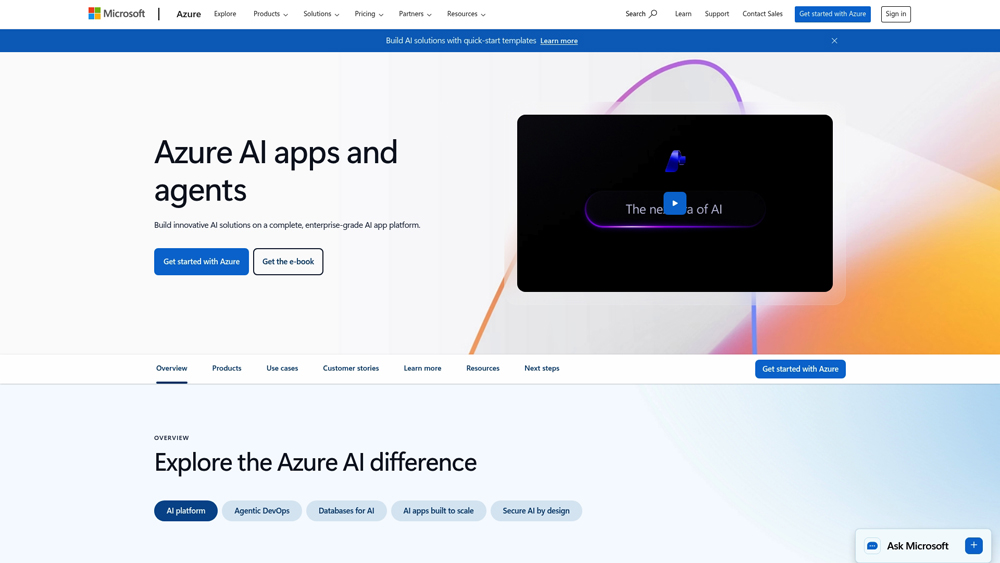
In-Depth Review & ML Infrastructure Analysis
Microsoft Azure AI has evolved into a unified AI platform that bridges the gap between raw compute and sophisticated application development. We evaluate its performance across its three core pillars: Azure AI Studio for development, Azure Machine Learning for MLOps, and the Azure OpenAI Service. This analysis focuses on how the platform handles the 2026 demand for agentic reasoning, multimodal processing, and private data grounding (RAG).
Key Takeaways: Pros, Cons & Quick Summary
This quick summary provides the core professional advantages and infrastructure considerations for choosing Azure AI as your development hub.
Key Advantages (Pros)
- Exclusive OpenAI Integration: The only cloud provider offering private, dedicated instances of GPT-4o, o1, and o3 with enterprise SLAs.
- Unified AI Studio: A single workspace for prompt engineering, model evaluation, and deployment across diverse model families.
- Enterprise Security (SOC 2/HIPAA): Leading-edge data sovereignty ensuring customer data is never used to train public models.
- Robust MLOps Pipelines: Deep integration with GitHub Actions and Azure DevOps for automated model testing and CI/CD.
- Massive Model Catalog: Includes Llama 3.1, Mistral, and Phi-3, alongside OpenAI’s flagship models.
Potential Drawbacks (Cons)
- Complex Pricing Structure: Managing token costs alongside compute clusters and storage requires specialized billing oversight.
- Steep Learning Curve: The sheer depth of the Azure portal can be overwhelming for developers new to the Microsoft ecosystem.
- Region Availability: Newest models (like o1-preview) often roll out to specific US regions first, causing latency hurdles for global users.
Core Features: Azure AI Studio & Prompt Flow
Azure AI offers a high-performance environment for building “Agentic” workflows. We focus on the features that allow developers to move from a single prompt to a complex, multi-tool AI application with ease.
-
Azure AI Studio & Prompt Flow: An advanced development tool that visualizes and orchestrates AI workflows, allowing developers to debug, iterate, and deploy multi-step LLM chains efficiently.
-
One Lake & Data Integration: Seamless “grounding” of AI models in enterprise data via Microsoft Fabric, enabling hyper-accurate Retrieval-Augmented Generation (RAG) without data duplication.
-
Azure OpenAI Service: Secure access to the world’s most powerful models (GPT-4o, o1-pro) with the ability to “provision throughput” for consistent performance during peak loads.
-
Content Safety & Moderation: Built-in enterprise filters that automatically detect and block harmful content, jailbreak attempts, and PII leaks in real-time.
-
Model-as-a-Service (MaaS): Deploy open-source models like Llama 3 or Mistral via serverless APIs, eliminating the need to manage underlying GPU infrastructure.
Scalable Infrastructure & Model Choice
In 2026, the competitive advantage of Azure AI lies in its hybrid approach to model architecture, allowing devs to choose between proprietary power and open-source flexibility.
- Reasoning Models (o1/o3): Azure provides the heavy-duty compute required for OpenAI’s ‘Thinking’ models, perfect for developers building complex scientific, coding, or mathematical applications.
- Phi-3 Mini to Large: Microsoft’s own Small Language Models (SLMs) offer incredible efficiency for edge computing and low-latency tasks where massive parameter counts aren’t required.
- GPU Clusters (ND H100 v5): For those performing custom training or fine-tuning, Azure provides massive NVIDIA H100 clusters, enabling the world’s fastest training times for custom weights.
MLOps, Reliability & Performance
For production AI, Azure AI is tested on its ability to maintain 99.9% uptime and handle millions of concurrent API calls with consistent token-per-second output.
- Global Model Deployment: Developers can deploy endpoints across 60+ regions, ensuring low-latency access for global user bases and compliance with local data residency laws.
- Unified Management: Through the Azure Portal, admins can monitor token usage, cost-per-project, and model performance metrics in a single dashboard, which is vital for corporate governance.
- Responsible AI Dashboard: A world-class toolset for evaluating model fairness, explainability, and bias before a tool is released to the public.
Azure AI Foundry Pricing & Production Value
Azure AI operates on a multi-tiered consumption model. In 2026, the best value is found in Global Standard deployments powered by Maia 200 chips. For strictly regulated industries, Data Zone pricing ensures data never leaves specific geographic boundaries (EU/US) at a slight premium. The Batch API remains the gold standard for non-real-time tasks, offering a flat 50% discount.
GLOBALEfficiency King$1.25
- Model: GPT-5.1 Global
- Output: $10.00 / 1M Tokens
- Tech: Maia 200 Optimized
- Best For: High-Volume Apps
BATCH API50% Cost Savings$0.63
- Discount: 50% off Global Rates
- Turnaround: 24-Hour Window
- Output: $5.00 / 1M Tokens
- Best For: Data Processing
PROVISIONEDReserved CapacityCustom
- Unit: PTU (Hourly/Monthly)
- Reliability: 0% Rate Limiting
- SLA: 99.99% Availability
- Best For: Tier-1 Enterprise
PRO TIP: In 2026, Azure has introduced Prompt Caching by default for most models; visitors should always check the official Microsoft Azure site for the most current prices and regional availability. If your prompt includes a long system instruction or a large document shared across multiple requests, you only pay $0.13 per 1M tokens for the cached portion, making RAG workflows significantly cheaper.
Production Value: The Agent Factory
Azure AI Foundry’s true production value in 2026 lies in Agent 365. This governance layer allows IT admins to manage AI agents like they manage user accounts. It provides Lineage Tracking (knowing exactly which model made which decision) and Automated Safety Guardrails that block toxic or sensitive data in real-time. With the Fairwater Super Factory, Microsoft’s liquid-cooled infrastructure, Azure now offers the lowest “tokens per watt” in the industry, allowing for 24/7 autonomous operations without the typical latency spikes found on smaller providers. For enterprises, this is the only platform that offers “Agentic DevOps” at a global scale.
Environments Supported
- Azure Cloud
- Hybrid (Arc)
- Edge Devices
- VS Code SDK
- GitHub Codespaces
- Docker/K8s
Development
- Python / .NET / Java
- REST APIs
- ML Studio (No-Code)
Compliance
- ISO / SOC / HIPAA
- FedRAMP High

Prompt Colleague Score
Quick Facts
- Platform: Azure AI Foundry (2026)
- Core Models: GPT-4.1 & GPT-5.1
- Agent Engine: Microsoft Agent 365
- Inference Tech: Maia 200 Silicon
- Best For: Secure Corporate AI Agents
- Free Tier: $200 Credit (Trial)
- Official Site: azure.microsoft.com
Pricing & Access (2026)
- Global (PAYG): Per 1M Tokens
- Batch API: 50% Off (24h turnaround)
- Provisioned (PTU): Hourly/Monthly
- Data Zone: Geographic Compliance
- Best Value: GPT-4.1 Global (Serverless)
Microsoft Azure AI: Frequently Asked Questions
Azure OpenAI is a specific service providing access to OpenAI’s models (GPT-4o, o1, etc.) with Azure security. Azure AI Studio is the comprehensive ‘hub’ or unified platform where you manage those models alongside open-source models (Llama, Mistral), orchestrate data, and build end-to-end AI agents.
Microsoft offers an Azure Free Account which includes a $200 credit for the first 30 days and 55+ services that are ‘always free’ within certain limits. This allows developers to prototype LLM applications and explore AI Studio without immediate upfront costs.
Azure AI is built on Microsoft’s ‘Responsible AI’ foundation. Your data is encrypted, stored within your chosen region, and—most importantly—is never used to train the base models provided by OpenAI or other third-party providers. It meets SOC, ISO, and HIPAA compliance standards.
Prompt Flow is a development tool designed to streamline the entire development cycle of AI applications. It allows you to visualize your LLM workflows, create executable graphs, and perform robust ‘evaluation’ to test how your model responds to different data inputs before going live.
Yes. Through the Azure AI Model Catalog, you have access to a vast range of open-source and frontier models including Meta’s Llama 3.1, Mistral Large, Cohere, and Microsoft’s own Phi-3 SLM family, all deployable via Serverless APIs.
Provisioned Throughput allows enterprises to reserve dedicated model processing capacity. Unlike the ‘Pay-as-you-go’ model where speed can fluctuate based on global demand, PTUs provide consistent latency and guaranteed throughput for high-scale production apps.
Enterprise AI & ML Infrastructure APIs
The professional utility of Microsoft Azure AI is centered on its API-first architecture, allowing organizations to integrate the GPT-4o and o1 ‘Thinking’ models directly into their proprietary stacks. In 2026, Azure’s API ecosystem provides more than just text completion; it offers managed endpoints for vision, speech-to-text, and real-time audio, enabling the creation of ‘Agentic’ workflows that can perform autonomous tasks across corporate databases and web services.
For ML engineers, Azure’s infrastructure is a great choice for ‘Grounding’ AI in private data. By utilizing Azure AI Search as a vector database, the API allows for high-fidelity RAG (Retrieval-Augmented Generation) with zero data leakage. This ensures that the AI’s responses are based entirely on your company’s internal documentation, spreadsheets, and records, delivered through a globally distributed, low-latency CDN.
Azure AI Service Categories:
- Azure OpenAI Service
- AI Health Insights
- AI Document Intelligence
- AI Video Indexer
- Multi-Language SDKs
- Cognitive Services API
- Managed MLOps Workflows
- AI Search (Vector DB)
- Computer Vision
- Agentic Orchestration
- Multimodal Inference
- Automated ML (AutoML)
ML & Developer Capabilities:
- Deep Learning Models
- Neural Machine Translation
- Anomaly Detection
- 1M+ Token Context Windows
- Private Endpoint Connectivity
- GitHub Copilot Integration
- Speech Synthesis Markup
- Real-time Speech Transcription
- Predictive Maintenance
- Semantic Ranker
- Cost Management Dashboards
- Custom Vision Training
DevOps & Governance:
- RBAC (Access Control)
- Regional Data Residency
- Managed Virtual Networks
- Audit Logging
- SLA Guarantees
- CI/CD for AI Models
- Model Performance Monitoring
- Bias & Fairness Testing
- Serverless Inference
- Hybrid Cloud (Azure Arc)
- VNET Support
- Private Link
- Azure Key Vault Integration
AI Orchestration & Deployment:
- Prompt Flow
- Semantic Kernel
- LangChain Support
- Vector Indexing
- Fine-Tuning Dashboards
- Model Benchmarking
- Kubernetes Deployments
- Serverless Batch APIs
Machine Learning Operations:
- Data Labeling
- Model Versioning
- Compute Instance Management
- Drift Detection
- Notebooks Integration
- Dataset Management
- GPU Cluster Scaling
- Python SDK v2
- ONNX Runtime
- AutoML for Tabular/Image
Product Features In Detail:
Azure AI is more than a simple model provider; it is a full-stack engineering environment. This section detail how the platform supports every stage of the AI lifecycle—from data ingestion and prompt engineering to model evaluation and production-grade deployment with full MLOps automation. For developers looking to build scalable, secure, and compliant AI solutions, these features represent the cutting edge of the ML Hub category.
A single pane of glass for all AI activities. Developers can switch between prompt engineering in the playground, exploring the model catalog for the best-performing LLM, and managing data indexes for RAG in one cohesive interface.
Integrated vector search capabilities allow developers to ground AI models in huge volumes of private data. It supports hybrid search (keyword + vector), ensuring that the retrieval process for your AI agents is the most accurate in the industry.
Azure allows you to consume open-source models like Llama 3 or Mistral via serverless APIs. You get the flexibility of open-source without the headache of managing the underlying GPU clusters or scaling infrastructure.
For applications requiring predictable latency and high token volume, PTUs provide dedicated compute capacity. This is essential for enterprise production workloads where ‘noisy neighbor’ issues on shared APIs cannot be tolerated.
A built-in suite of tools to debug and evaluate your models. It helps identify bias, explains how the model reached a decision, and ensures your AI remains compliant with internal ethics and external regulations.
Automatically filter out harmful content, hate speech, and jailbreak attempts. Azure Content Safety works in real-time on both inputs and outputs, providing a vital layer of protection for public-facing AI applications.
Azure guarantees that your data stays within your tenant. It is not used to train the base models (like GPT-4), ensuring that your corporate IP remains yours alone—a critical requirement for legal and financial sectors.
Turn prompt engineering into a rigorous engineering discipline. With Prompt Flow, you can version-control your prompts, run automated evaluations against test datasets, and deploy with the same CI/CD pipelines as traditional software.
The Top 4 AI Tools: Our Editors' Picks for Instant Productivity!
ChatGPT
AI Assistants
Google Gemini
AI Assistants

Midjourney
Image Generators
Otter.ai
Meeting Assistants