

Tabnine Review 2026: The Premier Secure AI for Software Engineering
Tabnine is an AI-driven development agent specifically designed to accelerate the software engineering lifecycle while maintaining strict data sovereignty. It integrates directly into major IDEs to provide context-aware code completions, automated documentation, and intelligent refactoring. Unlike generalized models, Tabnine focuses on security and privacy, allowing for local deployment and training on proprietary codebases without risking intellectual property exposure.
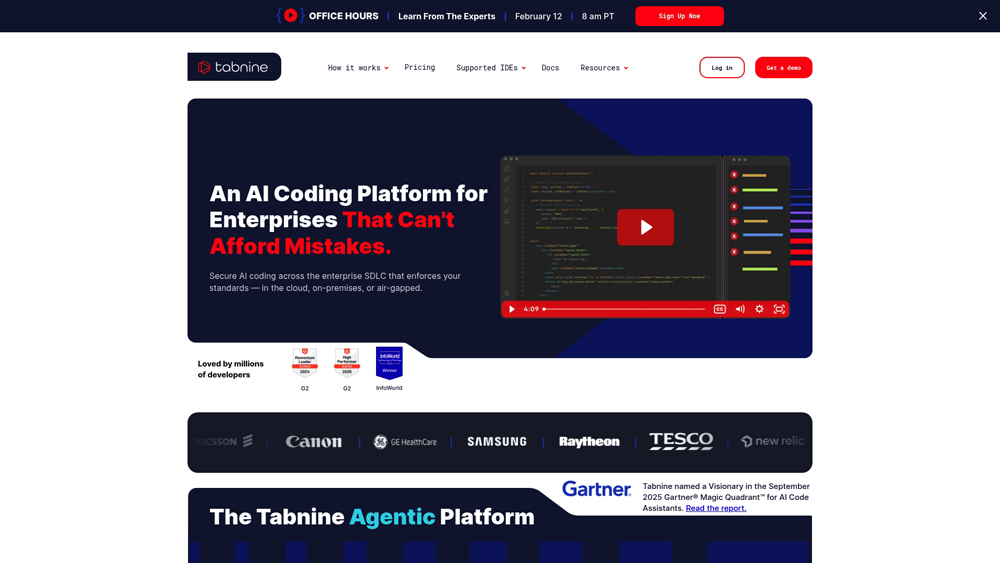
In-Depth Review & Agent Analysis
Tabnine has evolved into a sophisticated agentic platform that understands the nuances of enterprise-scale software architecture. We evaluate its performance based on its zero-trust security model, the quality of its specialized code-centric LLMs, and its ability to integrate with internal company standards. This analysis highlights why Tabnine is the preferred choice for regulated industries and large-scale engineering departments.
Key Takeaways: Pros, Cons & Quick Summary
This quick summary provides the core advantages and potential drawbacks of using Tabnine for professional software engineering.
Key Advantages (Pros)
- Absolute Privacy: Offers local deployment and zero-data-retention options to protect proprietary logic.
- Customized Learning: Can be trained on your specific codebase to follow internal naming conventions and patterns.
- Broad IDE Support: Seamlessly integrates with VS Code, JetBrains, Visual Studio, and Eclipse.
- Legal Compliance: Trained exclusively on permissively licensed open-source code to avoid IP legal risks.
- Low Latency: Optimized for real-time coding with high-speed local inference options.
Potential Drawbacks (Cons)
- Lacks General Knowledge: Not a general-purpose AI; excels at code but not creative writing or general search.
- Infrastructure Complexity: On-premises or private cloud deployment requires internal DevOps setup.
- Tiered Capability: Advanced context-awareness is significantly limited on the Basic free plan.
Core Features: Specialized Engineering Intelligence
Tabnine provides a hyper-focused suite of engineering tools that operate within the flow of development. Its agentic capabilities allow it to handle complex file-to-file logic rather than just isolated lines of code.
-
Private Model Training: Engineering teams can fine-tune Tabnine on their specific GitLab or GitHub repositories, ensuring the AI understands internal libraries and architectural choices.
-
Context-Aware Completions: By analyzing the entire project directory, Tabnine suggests code that is architecturally sound and consistent with existing patterns across multiple files.
-
AI Chat for Codebases: An integrated agent chat that allows developers to ask questions about their specific codebase, such as ‘Where is the auth logic handled?’ or ‘Refactor this to use our internal logger.’
-
Unit Test Generation: Automatically generates comprehensive test suites based on the logic within your functions, helping teams maintain high coverage with minimal manual effort.
-
Code Explanation & Documentation: Can instantly document complex legacy code or explain intricate logic to new team members, accelerating the onboarding process.
Agent Architecture and Security Innovation
The 2026 iteration of Tabnine utilizes a multi-model approach, allowing users to choose the right balance between speed and reasoning depth while keeping data entirely within their control.
- Switchable Models: Users can toggle between Tabnine’s proprietary, highly secure models or larger third-party models like Claude 3.5 or GPT-4o, depending on the complexity of the task and privacy requirements.
- Zero-Trust Security: Tabnine’s “Private Cloud” deployment ensures that your code never leaves your firewall and is never used to train public models, solving the primary barrier to AI adoption in enterprise.
- Language Coverage: Supports over 80 programming languages, with deep, specialized optimization for Java, Python, JavaScript, TypeScript, and C++.
Performance, Speed & Developer Experience
Tabnine is built to minimize friction, prioritizing “flow state” by delivering suggestions at the speed of thought without the lag often associated with cloud-only AI tools.
- Inference Speed: With local execution options, Tabnine provides completions in milliseconds, making it feel like a native feature of the IDE rather than an external plugin.
- Workflow Integration: It does not require developers to leave their environment. Commands, chat, and completions are all handled through the editor, keeping the cognitive load low.
- High-Fidelity Suggestions: Because it can be trained on your own code, the suggestions are significantly more relevant and require fewer manual edits compared to generic, general-purpose assistants.
Tabnine Pricing & Professional Value (2026)
Tabnine offers a scalable pricing model that grows from individual developers to the world’s largest regulated enterprises. With its focus on IP protection and codebase customization, it provides a unique ROI for teams managing sensitive or legacy software.
BASICStarter Devs$0
- Price: $0/mo
- Models: Basic Completions
- Limits: Single-file Context
- Best For: Hobbyists
ENTERPRISESecurity Focus$39
- Price: $39/user
- Deployment: On-Prem/VPC
- Training: Custom Training
- Best For: Large Teams
ULTIMATEMax ComplianceCustom
- Price: Contact Sales
- Privacy: Air-gapped Support
- Admin: Centralized Policy
- Best For: Gov & Finance
Note: Tabnine pricing reflects current 2026 enterprise rates. Discounts are often available for annual commitments or significant seat volumes. Features like private cloud deployment and codebase-specific training are reserved for the Enterprise and Ultimate tiers. Always verify the most recent pricing and security documentation at tabnine.com/pricing.
Product Details
Tabnine remains a top-tier choice for specialized AI engineering. It is the most secure and privacy-focused tool in the market, making it our primary recommendation for companies that must balance high-speed development with strict compliance and IP protection.
Platforms Supported
- Cloud
- On-Premises
- Windows
- Mac
- Linux
- IDE Plugins
Training
- Documentation
- Custom Training
Support
- Email
- Priority Enterprise Support

Prompt Colleague Score
Quick Facts
- Company: Tabnine
- Founded: 2017
- HQ: Tel Aviv, Israel
- Best For: Private & Air-Gapped Dev
- Core Tech: Enterprise Context Engine
- Models: Nemotron, Claude 3.7, Custom
- Official Site: tabnine.com
Pricing & Access
- Pro Tier: $12 – $15/mo
- Enterprise: $39 – $59/user
- VPC/On-Prem: Custom Quote
- Free Tier: Limited Trial (SaaS)
- Note: Pricing based on Agent usage
Frequently Asked Questions (FAQ)
Tabnine offers a ‘Zero Data Retention’ policy. Unlike generic AI tools, it can be deployed on-premises or in a VPC. It never trains its global models on your proprietary code, ensuring your intellectual property remains entirely within your secure network infrastructure.
Yes. One of Tabnine’s standout 2026 features is its ability to run fully offline on local hardware (like Dell PowerEdge servers). This makes it the preferred choice for defense, healthcare, and financial sectors with strict no-cloud policies.
Enterprise users can connect their private repositories (GitHub, GitLab, Bitbucket) to Tabnine. The AI then learns your organization’s specific internal libraries, APIs, and patterns, delivering suggestions that feel like they were written by your own senior architects.
Yes. The Tabnine Agentic Platform allows admins to ‘Bring Your Own Model’ (BYOM). You can switch between Tabnine’s proprietary permissive models or plug into third-party LLMs like Claude 4.5 or GPT-o3 via secure API tokens.
Tabnine now integrates directly with Atlassian Jira. It can read a ticket, plan a multi-file solution, and generate the code fix automatically. It then validates the code against the Jira requirements before presenting it for human review.
Tabnine’s models are trained exclusively on permissively licensed code (MIT, Apache). The Provenance feature scans every suggestion in real-time to ensure no GPL or copyleft code is introduced, protecting your company from legal licensing risks.
Engineering Intelligence & Agentic APIs
The Tabnine Agentic Platform represents a massive leap from simple ‘Ghost Text’ to full-lifecycle automation. In 2026, the platform provides a robust API-first architecture that allows engineering leads to govern AI usage across the entire SDLC. This includes the ‘Usage & Audit’ APIs, which give enterprises granular visibility into developer productivity factors and automation rates while ensuring SOC 2 compliance through rigorous logging of all AI-human interactions.
Beyond the IDE, the Tabnine Control Plane allows for the centralized management of Model Context Protocol (MCP) servers. This enables the AI agents to interact with internal documentation, CI/CD pipelines, and cloud monitoring tools. By leveraging hybrid search (combining dense and sparse vectorization), the platform ensures that the AI has the most relevant context from your remote codebase, significantly reducing hallucinations and errors.
AI Engineering Capabilities:
- IDE Code Completion
- Legacy Code Modernization
- Refactoring Agent
- Permissive Data Training
- Multi-Language (80+)
- Semantic Code Search
- Jira Ticket Resolution
- Local Context Engine
- Image-to-Code (Figma)
- Agentic Multi-File Editing
- Test Case Generation
- Architectural Reasoning
Enterprise Control:
- Private Model Training
- SOC 2 Type II Compliance
- Audit Logs API
- Single-Tenant VPC
- On-Prem / Air-Gapped Setup
- Code Provenance Checking
- Zero Data Retention
- SSO / IdP Integration
- Predictive Analytics
- Censorship Controls
- Monthly Cost Caps
- Team Lead Dashboards
Agentic Workflow Features:
- Jira Ticket Linking
- Pull Request Summaries
- Documentation Agent
- Schema Generation
- Linting & Fix Suggestions
- Cross-File Reasoning
- Long-Term Project Context
- Bring Your Own LLM (BYOM)
- Unit Test Automation
- Dependency Analysis
- Visual UI Generation
- Migration Assistant
- Custom CLI Agents
Software Development Life Cycle:
- Automated Fixing
- Security Scanning
- Vulnerability Patching
- Hybrid Context Retrieval
- Performance Optimization
- Babel/Build Config Assist
- Git Integration
- CI/CD Pipeline Sync
Natural Language to Code Logic:
- Natural Language Prompts
- SQL Query Generation
- Complex Logic Transformation
- Intent-Based Architecture
- Knowledge Graph Context
- Code-to-English Translation
- Markdown Documentation Gen
- Boilerplate Scaffolding
- YAML/JSON Config Assist
- Comments-to-Function
Product Features In Detail:
Beyond its reputation as a pioneer in AI code completion, Tabnine has evolved into a sovereign intelligence platform for modern engineering teams. This detailed FAQ provides technical insights into how Tabnine’s agentic architecture allows for safe, localized AI deployment that integrates directly with Atlassian Jira and private Git repositories. These features are critical for organizations that require the power of AI without the risks associated with third-party data retention or public cloud leakage.
Tabnine’s core strength is its ‘Enterprise Context Engine.’ It doesn’t just look at the current file; it indexes your entire remote codebase to understand internal APIs and architectural standards, ensuring suggestions are project-specific rather than generic.
For industries like Banking or Defense, Tabnine is the only AI agent that can be deployed fully air-gapped on your own hardware. This guarantees that your source code never leaves your data center and is never stored on external servers.
Tabnine’s award-winning Code Review Agent automatically checks pull requests against your company’s custom style guides and security policies. It can flag architectural anti-patterns and suggest fixes before a human even opens the PR.
Developers can drop Figma mockups or UI screenshots directly into the Tabnine chat. The AI agent analyzes the visual layout and generates the corresponding React, Vue, or Tailwind CSS code that matches your existing component library.
The platform can ingest Jira tickets, identify the relevant files to edit, and propose a complete solution. It includes a validation step that runs unit tests to ensure the AI-generated fix actually resolves the ticket before submission.
Admins have total control over the underlying LLM. You can use Tabnine’s proprietary models for maximum speed and privacy, or enable secure endpoints for frontier models like Claude 4.5 or GPT-o3 for complex reasoning tasks.
To avoid ‘IP Poisoning,’ Tabnine real-time scans all suggestions for open-source license compliance. It can block code that matches GPL or restricted licenses, providing a full audit trail for legal and compliance teams.
Tabnine excels at ‘Repo Grokking’ for legacy systems. It can analyze monolithic Java or C# codebases, explain undocumented logic, and assist in refactoring them into modern microservices or cloud-native architectures.
The Top 4 AI Tools: Our Editors' Picks for Instant Productivity!
ChatGPT
AI Assistants
Google Gemini
AI Assistants

Midjourney
Image Generators
Otter.ai
Meeting Assistants